Best Balance Bikes in the UK 2026
The best balance bikes for families who want to help a child practise balance, steering, and independent riding before a pedal bike becomes the right next step.
Why are scores between 9 and 10?
This is a curated shortlist of strong picks, not a full best-to-worst ranking. Small score gaps usually mean we have slightly more evidence for one model than another, not that the lower-scoring option is a poor choice.
So this is just another affiliate roundup with an arbitrary order?
No. We make these lists good enough that we use them ourselves and recommend them to friends and family. We turn the kind of research careful parents would normally do by hand into a repeatable process. Then we compare the evidence across the markets we cover and rank products with a model that gives more weight to stronger signals instead of simple averages or a fully hand-picked order based purely on editorial preference.
Affiliate Disclosure
We use affiliate links and ads to finance this website. As an Amazon Associate I earn from qualifying purchases.
- Rank #1 Our score: 9.92 / 10
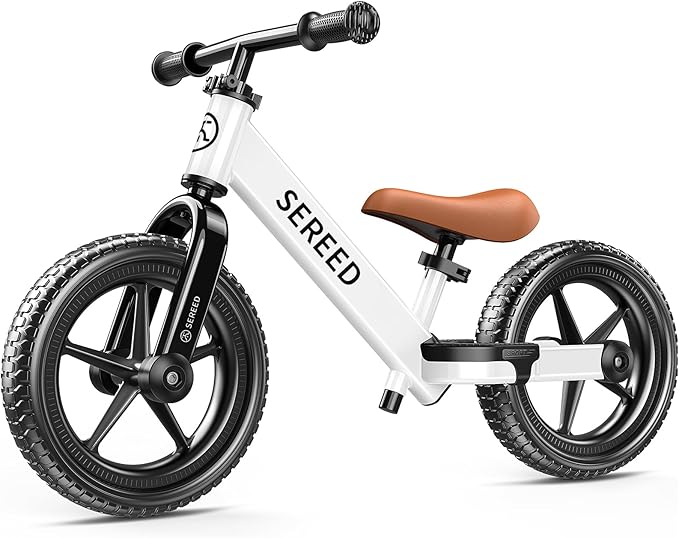
SEREED Tool-Free Balance Bike
Best: Mid-range
SEREED Tool-Free Balance Bike suits a smaller preschool rider who needs a low 29.9 cm/11.8 in starting saddle and frequent fit adjustments without tools. Its 12-inch foam tyres and 3.5 kg/7.7 lb frame keep maintenance and carrying simple, while the 41.9 cm/16.5 in maximum saddle should be checked against expected growth.
Pros
- The 29.9-41.9 cm/11.8-16.5 in saddle and 49.7-57.1 cm/19.6-22.5 in handlebar both adjust without tools, making fit changes unusually straightforward.
Cons
- Foam tyres give less grip and bump absorption than pneumatic tyres on rough or wet routes, and taller children may exhaust the 41.9 cm/16.5 in saddle maximum.
- Rank #2 Our score: 9.91 / 10
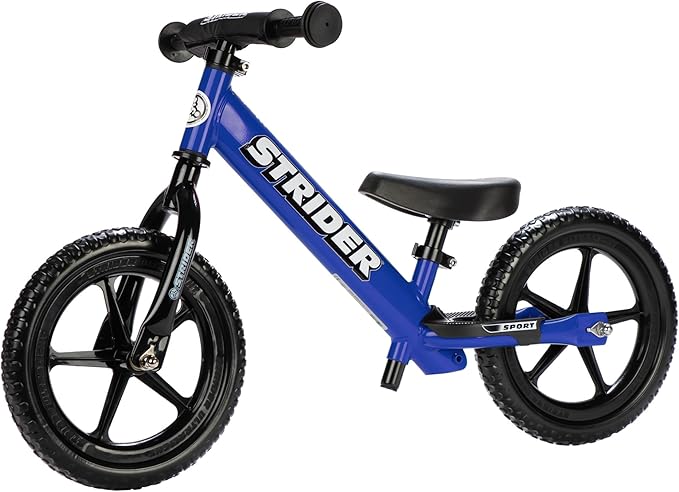
Strider 12 Sport
Best: Premium
Best when you want the normal Strider fit range without paying extra for the lighter Pro frame.
Strider 12 Sport suits a smaller toddler starting on a real two-wheel learner, with a low published fit range and tool-free adjustment. Flat-free tyres keep maintenance simple, while families using rough paths may prefer the cushioning of air tyres.
Pros
- The low seat range and mini grips make early fit easier to verify.
Cons
- Foam tyres transmit more chatter than air tyres on broken paths.
- Rank #3 Our score: 9.88 / 10
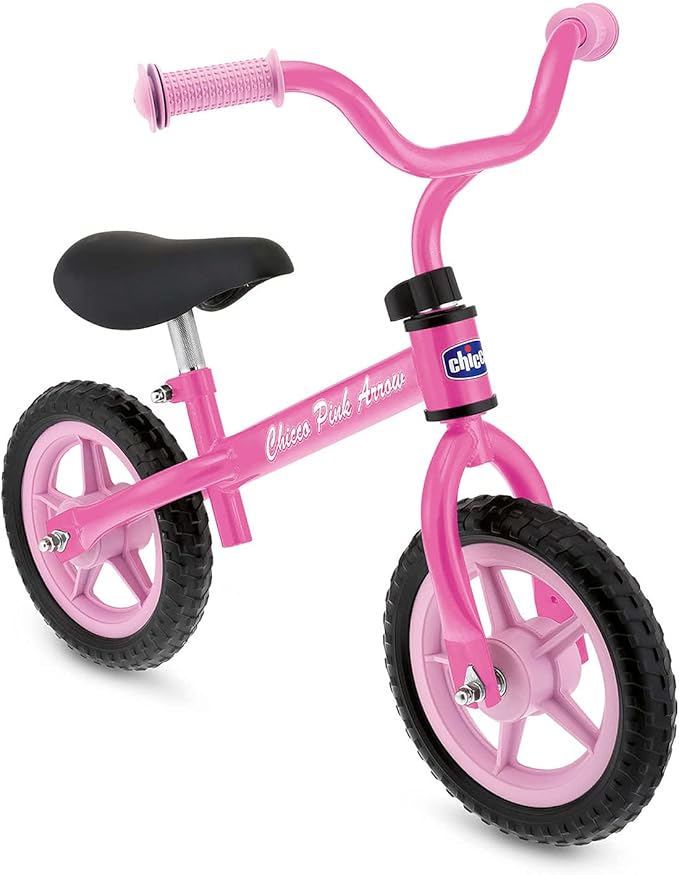
Chicco Pink Arrow Balance Bike
Best: Affordable
Chicco Pink Arrow suits a child within the stated 2–5 age range who is learning to balance. Its adjustable saddle and handlebar and puncture-resistant tyres that need no inflation keep setup and pre-ride upkeep simple. The fit limit is less clear: Chicco gives a 25 kg/55.1 lb maximum and overall dimensions of 71 cm/28 in × 45 cm/17.7 in × 60 cm/23.6 in, but no saddle height. Check the lowest seat position with your child; those published figures cannot show whether both feet reach the ground.
Pros
- Puncture-resistant tyres need no inflation, while the saddle and handlebar adjust.
Cons
- Chicco gives no minimum saddle height, so its age and load limits cannot confirm fit.
- Rank #4 Our score: 9.88 / 10
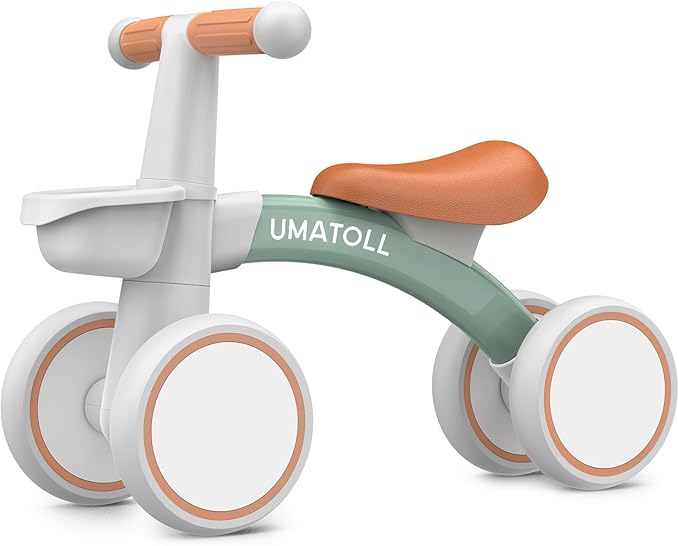
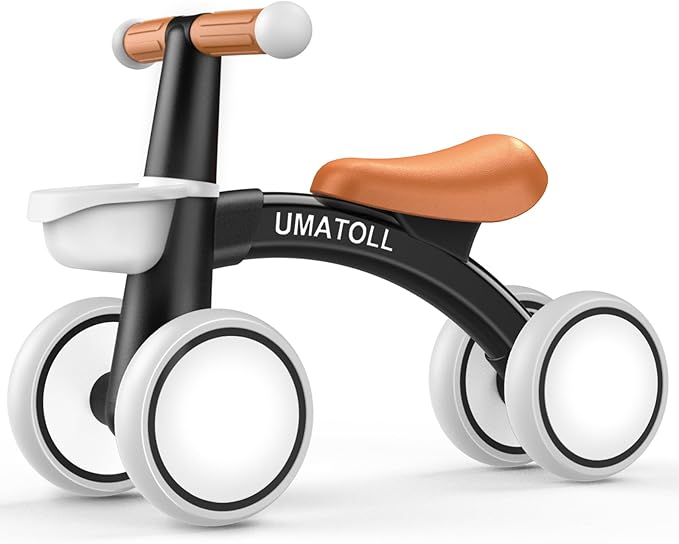
Umatoll Four-Wheel Toddler Balance Bike
Best: Four-wheel first bike
The 1.5 kg/3.3 lb Umatoll B402 gives a 12–24-month toddler four-wheel support for early pushing and steering. Its removable basket adds somewhere to carry a small toy, while EVA foam wheels need no inflation. The saddle has three forwards-and-backwards positions—not three heights. It is a short first-riding stage before a two-wheel balance bike, with a 25 kg/55.1 lb rider limit.
Pros
- The saddle moves forwards and backwards in three positions to change the distance to the handlebar.
Cons
- Four wheels support the child but provide less sideways balance practice than a two-wheeler.
- Rank #5 Our score: 9.85 / 10
Umatoll Baby Balance Bike
Best: Stable first bike
Umatoll Baby Balance Bike is a stable first ride-on for 12-24 month children, with a 1.5 kg/3.3 lb frame, adjustable seat, and quiet EVA wheels. It belongs before a two-wheel learner.
Pros
- Four-wheel layout and 12-24 month fit suit a child who is not ready for a two-wheel runner.
Cons
- The four-wheel base builds confidence, but it will not teach lean-and-glide steering like a conventional two-wheel balance bike.
- Rank #6 Our score: 9.84 / 10
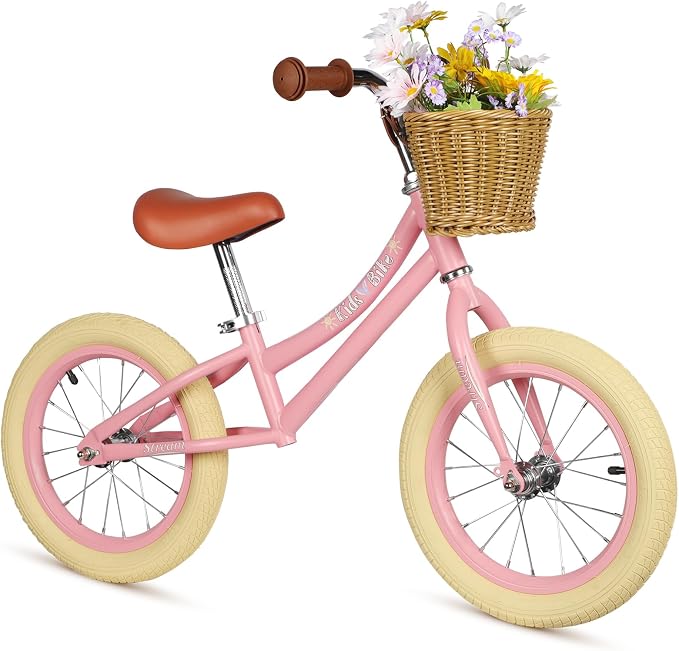
Stream Balance Bike
Stream Balance Bike is a simple 30.5 cm/12 in two-wheel learner for roughly 2-6 year olds, with a 36-41 cm/14.2-16.1 in saddle range and EVA solid tyres. It fits basic smooth-ground practice.
Pros
- 36-41 cm/14.2-16.1 in saddle range and 80-120 cm/31.5-47.2 in height guidance cover many toddler-to-preschool riders.
Cons
- The buying decision still depends on matching the minimum saddle height to inseam.
- Rank #7 Our score: 9.81 / 10
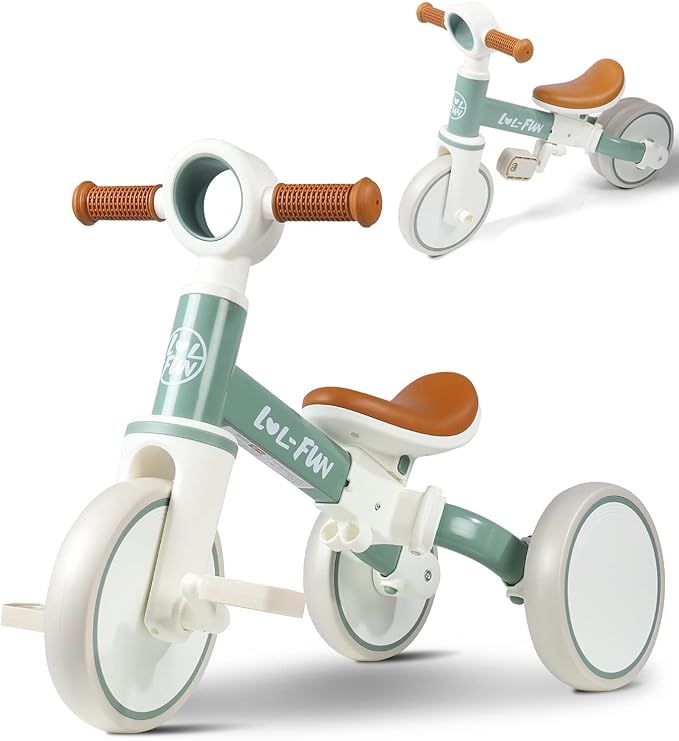
LOL-FUN 4-in-1 Convertible Balance Bike
LOL-FUN 4-in-1 Convertible Balance Bike suits a family wanting one small cycle to switch between stable tricycle, pedal-free two-wheel and pedalling modes from roughly one to four years. The conversion can support changing confidence, but every setup change must be locked correctly and the broad age range is no substitute for checking saddle height and leg reach.
Pros
- Reconfigurable rear wheels and removable pedals let the same frame move from stable riding to two-wheel balance practice and then pedalling.
Cons
- A convertible adds joints and setup choices that must be checked carefully each time, and the listing provides no precise saddle range for fit decisions.
- Rank #8 Our score: 9.80 / 10
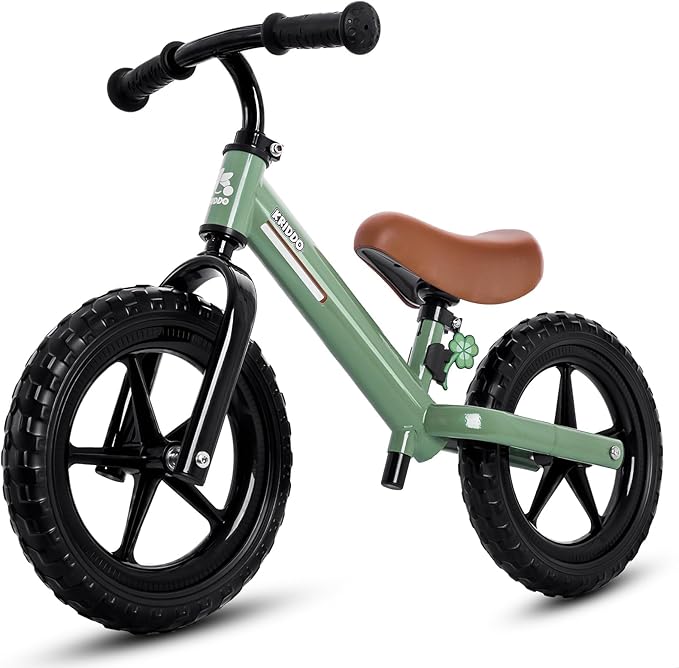
KRIDDO Dual Bearing Balance Bike
KRIDDO Dual Bearing Balance Bike is a preschool-focused two-wheel balance bike. Foam tyres keep maintenance simple, while the main buying check is still whether the saddle range matches your child now.
Pros
- Light 2.6 kg/5.7 lb frame should be manageable for many preschoolers.
Cons
- Official specs are less clear about saddle-height range than ideal.
- Rank #9 Our score: 9.80 / 10
Globber Learning Bike (Coconut)
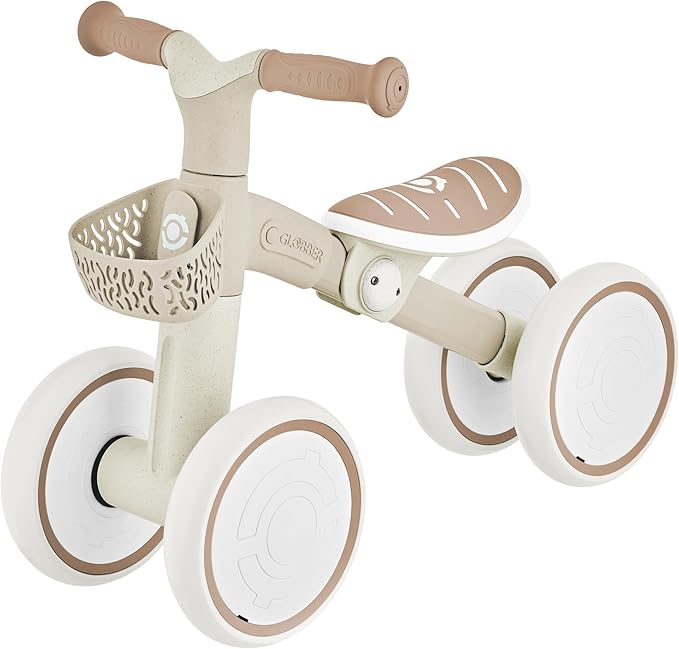
A four-wheel walking bike for toddlers aged 12 to 36 months. Its tool-free design and EVA foam wheels keep setup and routine care simple. Check that your child can sit comfortably and place both feet on the ground; age alone does not confirm fit. The four-wheel layout suits an early learning stage before two-wheel balance practice.
Pros
- Tool-free setup and EVA foam wheels keep assembly and routine care simple.
Cons
- Four wheels suit an early learning stage; children ready to practise on two wheels need a different stage.
- Rank #10 Our score: 9.79 / 10
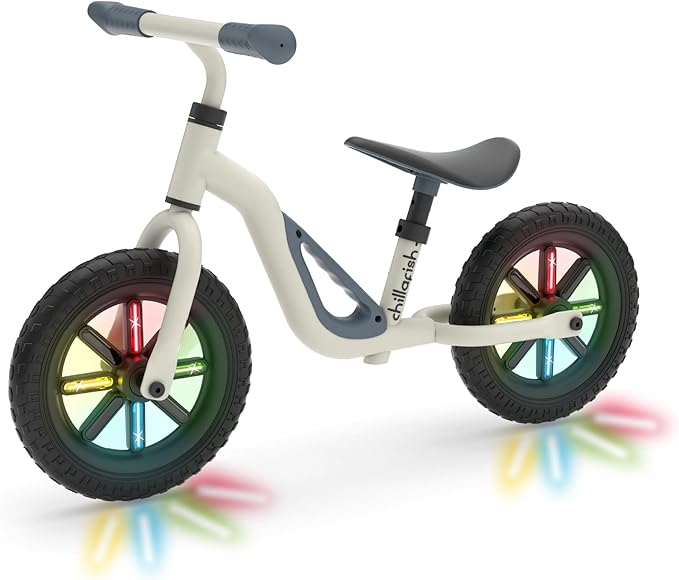
Chillafish Custom Ride
Chillafish Custom Ride suits toddlers starting short, supervised balance practice on a small two-wheel bike. Double-check the seat-height range, because confidence today matters more than buying extra growing room.
Pros
- Small, light format is approachable for a toddler moving beyond ride-on toys.
Cons
- Compact sizing may be outgrown sooner by taller preschoolers.
- Rank #11 Our score: 9.79 / 10
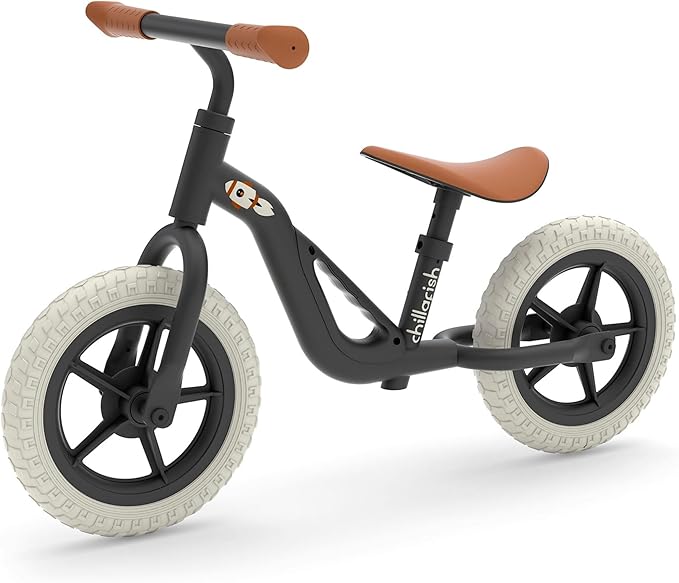
Chillafish Charlie
Chillafish Charlie weighs 2.5 kg/5.5 lb and starts with a 28 cm/11 in saddle, making it worth considering for small riders who need an easy-to-carry first two-wheeler. Its 10-inch EVA tyres need no pumping, but the 37 cm/14.6 in saddle ceiling limits growing room and the solid tyres favour smooth, dry paths.
Pros
- The 28-37 cm/11-14.6 in saddle range gives smaller riders a low starting position.
Cons
- Limited saddle height and solid 10-inch tyres make this a short-distance starter, not a rough-path or long-term preschool bike.
- Rank #12 Our score: 9.79 / 10
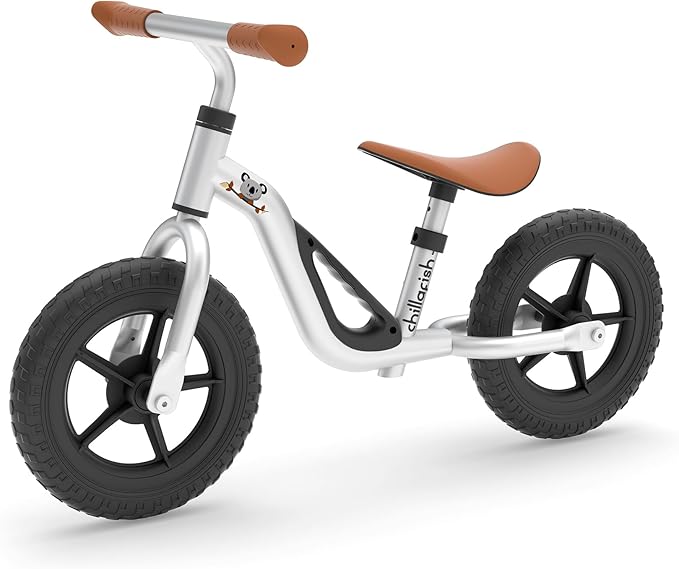
Lightweight Kids' Balance Bike
Chillafish Lightweight Kids' Balance Bike fits families who want an easy-to-carry first two-wheeler with puncture-proof tyres and adjustment. It is more about low-friction short practice than a premium bike feel.
Pros
- Carry handle and lightweight build help when the ride turns into walking.
Cons
- Puncture-proof tyres trade maintenance ease for less cushion on rough ground.
- Rank #13 Our score: 9.79 / 10
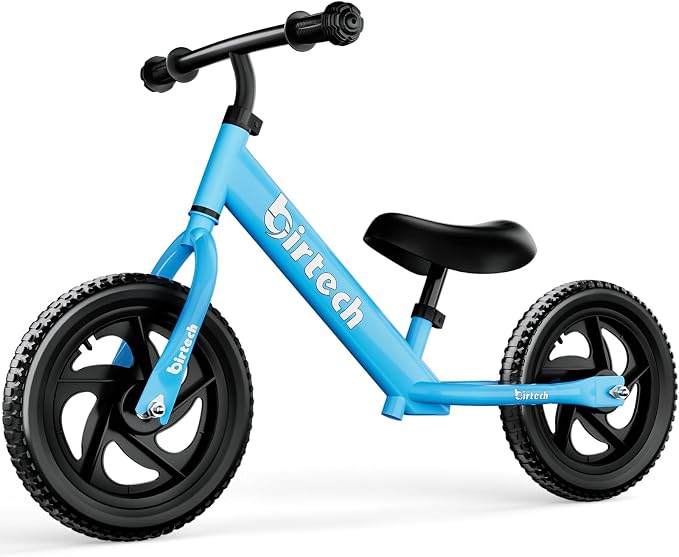
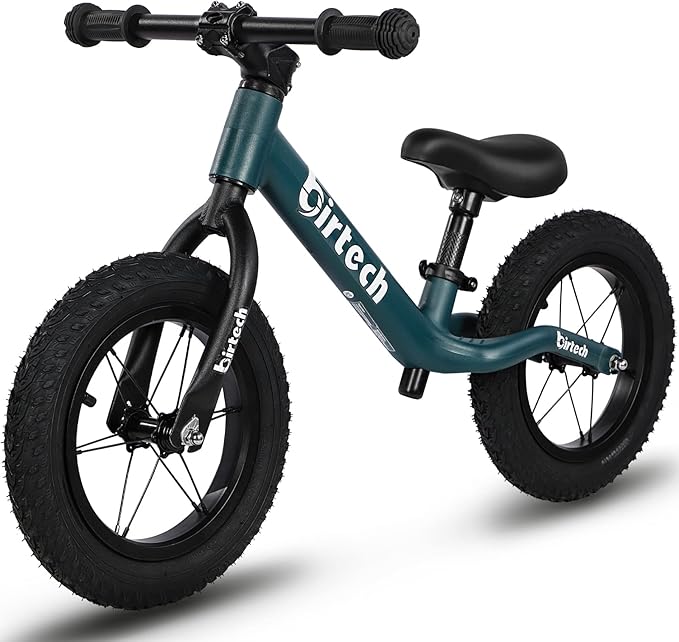
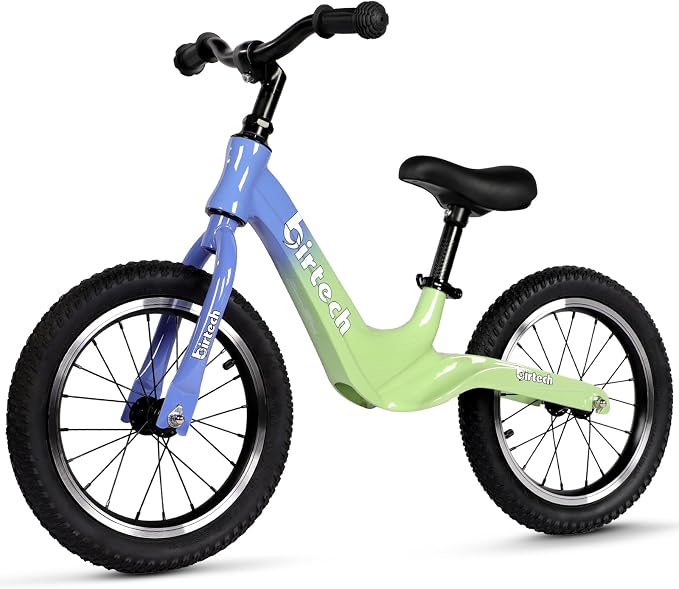
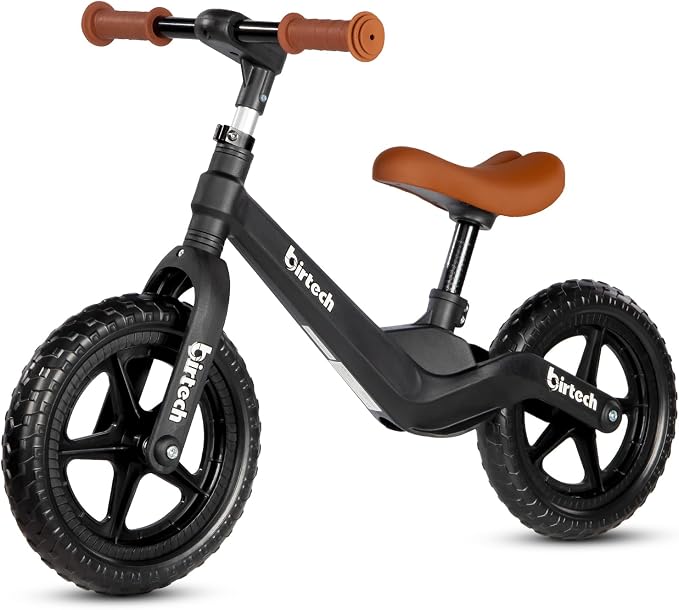
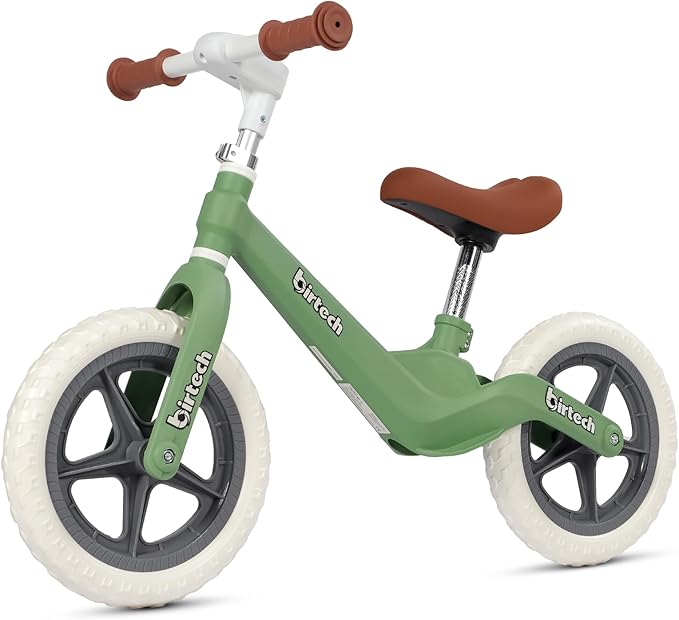
Birtech Balance Bike
Birtech Balance Bike is the budget fit-check option in this UK balance-bike set: a simple two-wheel learner with foam tyres for short pavement practice. It suits families testing whether a preschooler will stride and coast, but the saddle range matters more than the age label.
Pros
- Budget two-wheel setup keeps the first balance-bike decision simple.
Cons
- Still needs saddle-height checking before a smaller preschooler rides.
- Rank #14 Our score: 9.79 / 10
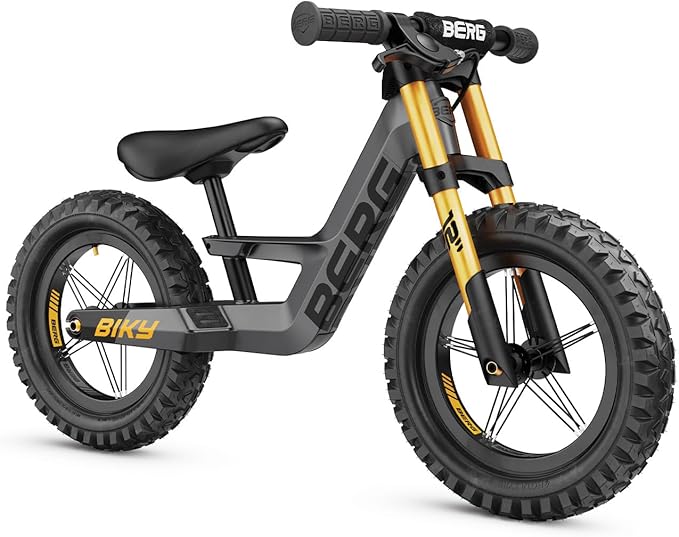
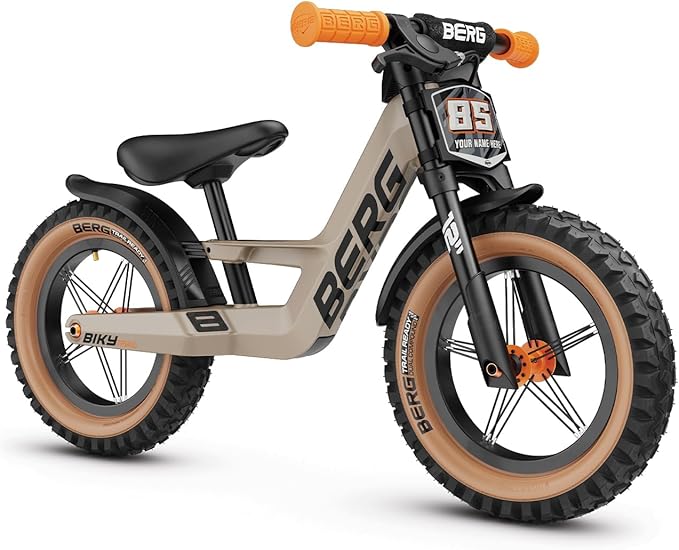
BERG Biky Cross
BERG Biky Cross suits a preschooler ready for a sportier 12-inch balance bike with pneumatic tyres and a hand brake. Check saddle fit, confident feet-down stopping and brake reach together; a lower, simpler bike may suit a cautious first starter better.
Pros
- Pneumatic tyres, a hand brake and a light magnesium frame suit faster practice on less-even park paths.
Cons
- The hand brake helps only when the child can reach and operate it without losing a stable riding position.
- Rank #15 Our score: 9.78 / 10
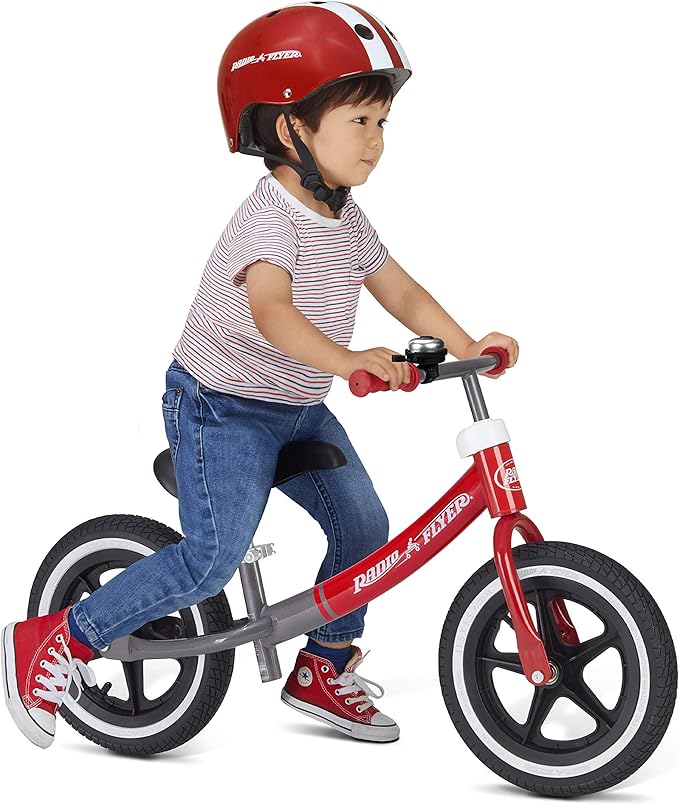
Radio Flyer Air Ride Balance Bike
Radio Flyer Air Ride is a 30.5 cm/12 in air-tyre learner for outdoor practice where ride comfort matters more than zero maintenance. The tool-free seat helps during growth spurts, but a small toddler still needs the actual minimum saddle setting checked.
Pros
- Air tyres cushion rough pavement better than foam tyres.
Cons
- Air tyres add pressure checks and puncture chores.
- Rank #16 Our score: 9.72 / 10
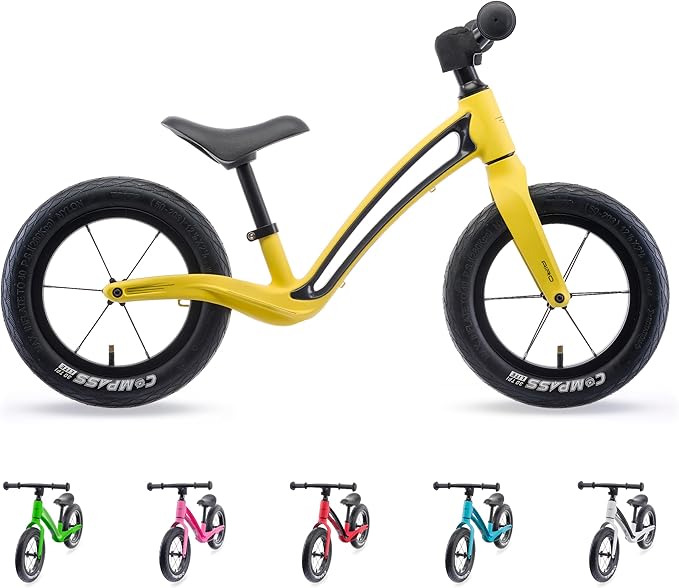
Hornit AIRO 12
Hornit AIRO 12 is a light air-tyre learner for families who want more cushioning than foam tyres without a heavy frame. Its 30-46 cm/11.8-18.1 in inside-leg guidance is useful, but air tyres add pressure checks and puncture risk.
Pros
- At about 3 kg/6.5 lb, it is easier to carry than many air-tyre bikes.
Cons
- Air tyres need pressure maintenance and can puncture.
- Rank #17 Our score: 9.72 / 10
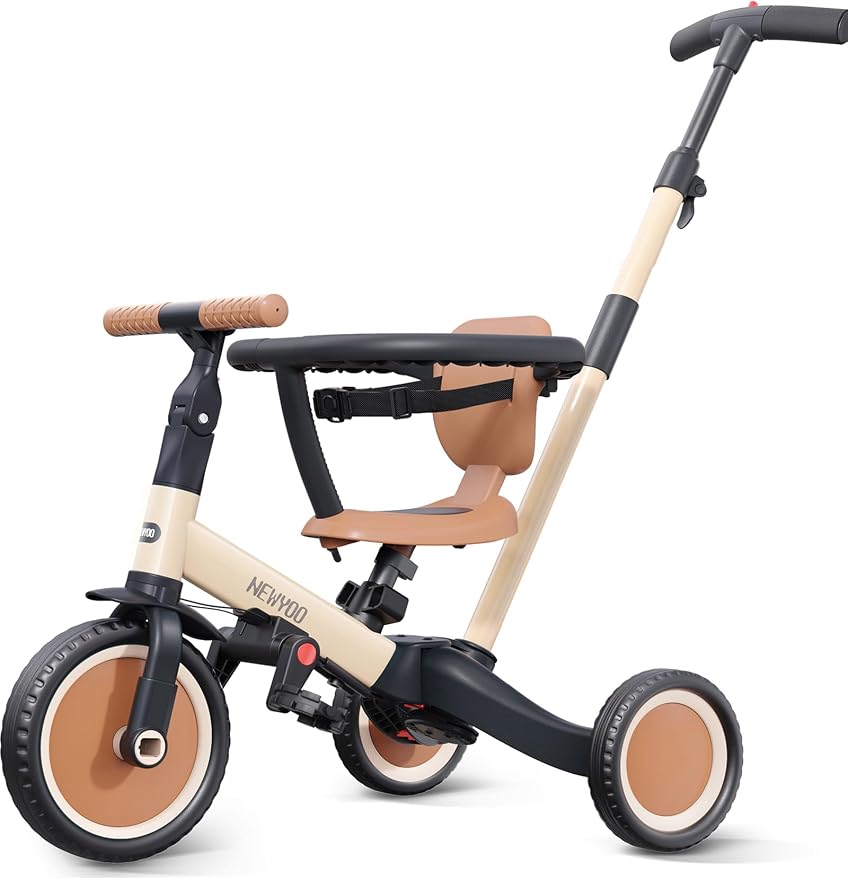
Newyoo TR008 5-in-1 Balance Bike
The Newyoo TR008 Khaki converts through five riding modes, including child-led balance practice. The manufacturer gives an age range of 1–3 years and a child-height range of 73.9-115.1 cm/29.1-45.3 in for the trike overall, but no separate age range for balance-bike mode. Check the instructions and reach in the selected setup, and recheck the fit after every conversion. Paired rear wheels make this a stable-first convertible rather than a conventional two-wheel balance bike.
Pros
- The parent steering handle lets an adult guide the TR008 while the child gets used to the riding position.
Cons
- The bar and steering handle do not make this a pushchair; check the wheel and pedal setup and the child’s fit after each conversion.
- Rank #18 Our score: 9.71 / 10
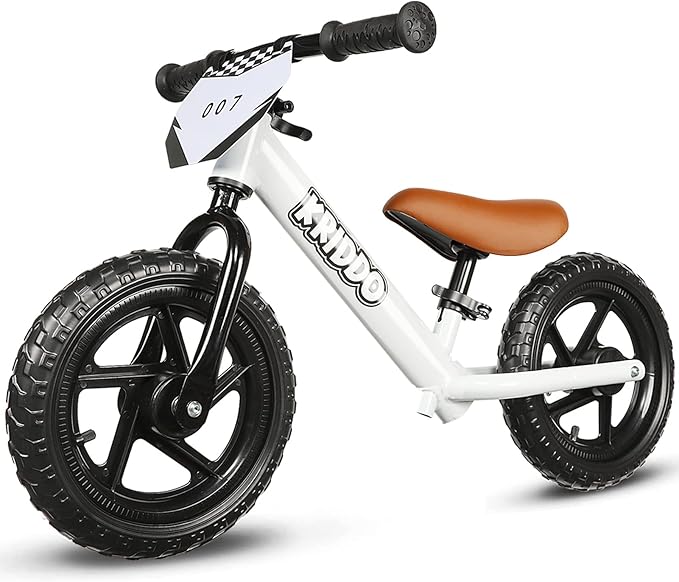
KRIDDO Kids Balance Bike
KRIDDO Kids Balance Bike is a conventional two-wheel learner for toddlers and preschoolers ready to practise gliding rather than use a four-wheel ride-on. Adjustable saddle and handlebar positions add growth room, while the puncture-resistant tyres reduce upkeep; check the lowest saddle against the child’s inseam before relying on the broad 2–5 year range.
Pros
- Adjustable saddle and handlebar positions give a better growth path for two-wheel balance practice.
Cons
- It is less forgiving than a four-wheel first bike for a very cautious or newly mobile toddler.
- Rank #19 Our score: 9.71 / 10
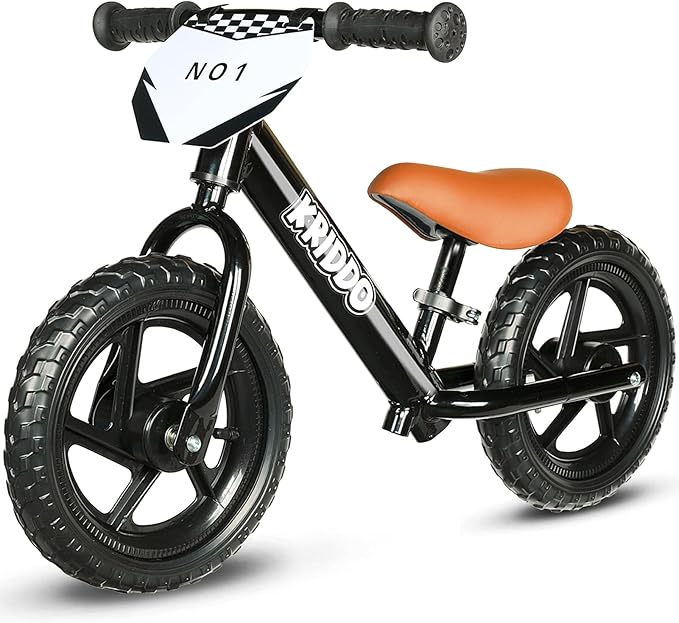
KRIDDO Toddler Balance Bike
The regular KRIDDO Classic combines a personalised front plate with a 30.5 cm/12 in two-wheel frame and adjustable saddle and handlebar. Check seated foot reach before choosing it for pushing and gliding practice. It has no footrest and the rider stops with their feet.
Pros
- Saddle and handlebar adjustment help find a comfortable position for foot-powered practice.
Cons
- There is no footrest or hand brake; check ground contact and stopping control rather than relying on the two-to-five-year label.
- Rank #20 Our score: 9.70 / 10
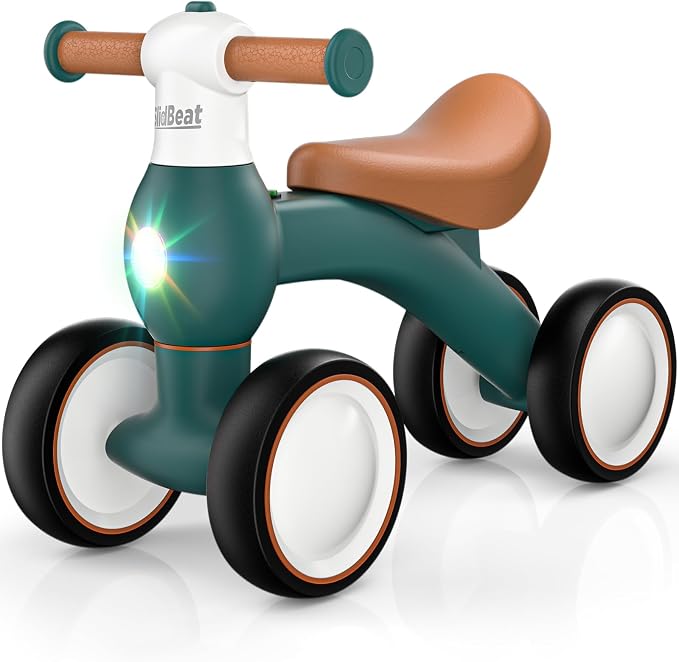
SLIDBEAT Light-Up Baby Balance Bike
SLIDBEAT Light-Up Baby Balance Bike is a four-wheel starter ride-on for roughly 10–24 months, with enclosed foam wheels and a 135-degree steering limiter for low-speed indoor or patio practice. The lights add interest rather than riding function, and the listing's implausible weight figure means parents still need the real product weight and saddle height before choosing it.
Pros
- Enclosed four-wheel running gear and limited steering reduce wheel contact and sudden oversteer for a very early rider.
Cons
- The stable four-wheel layout offers less balance progression than a two-wheeler, while the seller's 15.9 kg/35 lb product-weight claim is clearly unreliable.
- Rank #21 Our score: 9.68 / 10
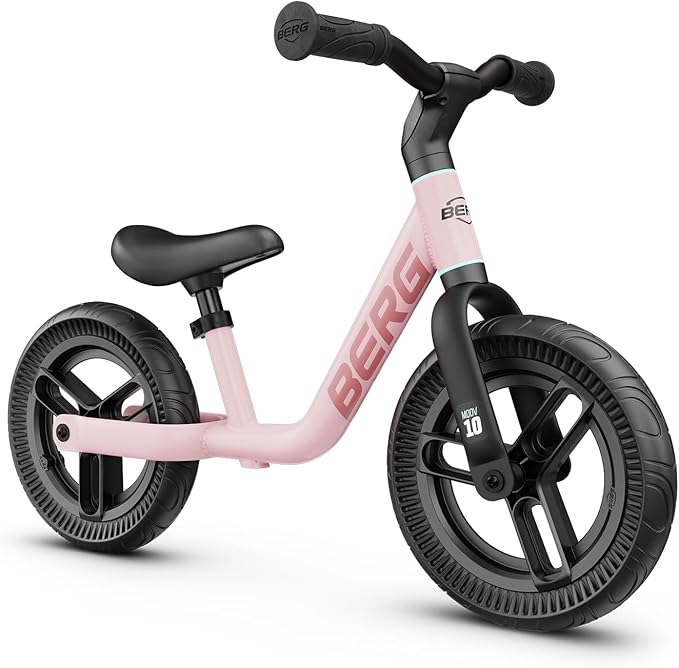
BERG MOOV 10
For children 85-110 cm/33.5-43.3 in tall; compare inseam and foot reach. BERG lists the specific MOOV 12 for 90-120 cm/35.4-47.2 in.
The BERG MOOV 10 is a lightweight first balance bike for children 85-110 cm/33.5-43.3 in tall, with adjustable saddle and handlebar and puncture-proof EVA tyres. It weighs 2.7 kg/6 lb, making it easier for a small rider to move or carry. The solid EVA tyres need less maintenance than air tyres but cushion less over rough ground. BERG does not publish the saddle-height range, so check the lowest position against the child’s inseam and confirm both feet reach the ground with knees slightly bent. Supervise practice on level, traffic-free ground.
Pros
- At 2.7 kg/6 lb, the bike is easier for a small rider to lift and manoeuvre.
Cons
- BERG lists the MOOV 10 for 85-110 cm/33.5-43.3 in and the MOOV 12 for 90-120 cm/35.4-47.2 in; wheel size alone does not establish fit.
- Rank #22 Our score: 9.66 / 10
Hello-5ive Balance Bike
Hello-5ive Balance Bike is a two-wheel preschool balance bike for families who expect rougher paths where air tyres help. Check puncture upkeep and seat-height range before choosing it over a lower-maintenance foam-tyre bike.
Pros
- Straightforward two-wheel format covers normal preschool balance practice.
Cons
- Age labels are not enough; saddle height still needs checking.
- Rank #23 Our score: 9.66 / 10
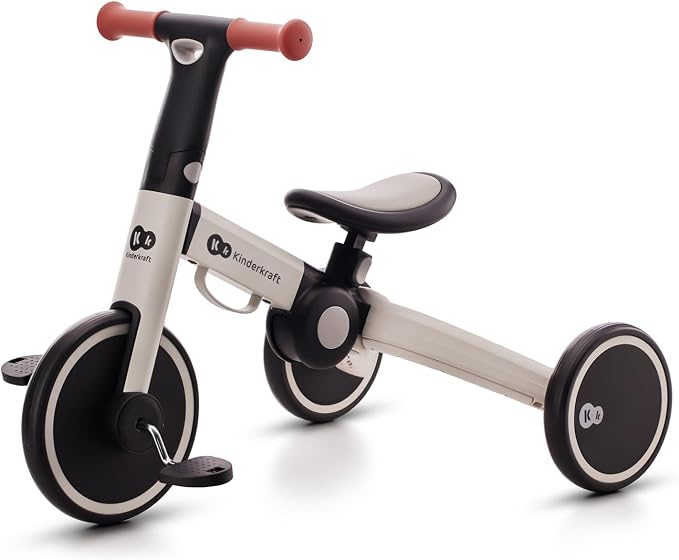
Kinderkraft 4TRIKE 3-in-1 balance bike
The Kinderkraft 4TRIKE changes between a mini push-toy bike, a mini balance bike and a pedal tricycle. In push-toy mode, your child practises moving forward with alternating leg pushes; this is child-powered, not a parent-guided push configuration. The balance-bike setup also lets your child move independently, while the pedal trike supports a later riding stage. Its seat adjusts from 29.5-31.5 cm/11.6-12.4 in and the frame folds for storage. Check ground reach in the chosen setup, secure each fitting after conversion, and supervise use on flat, unobstructed ground away from traffic.
Pros
- The same frame supports three-wheel foot propulsion, a mini balance mode and pedal-tricycle practice, rather than only one learning setup.
Cons
- Rear-wheel position 2 is for storage, not riding; balance mode requires the pedals removed and the metal rear connector fitted.
- Rank #24 Our score: 9.65 / 10
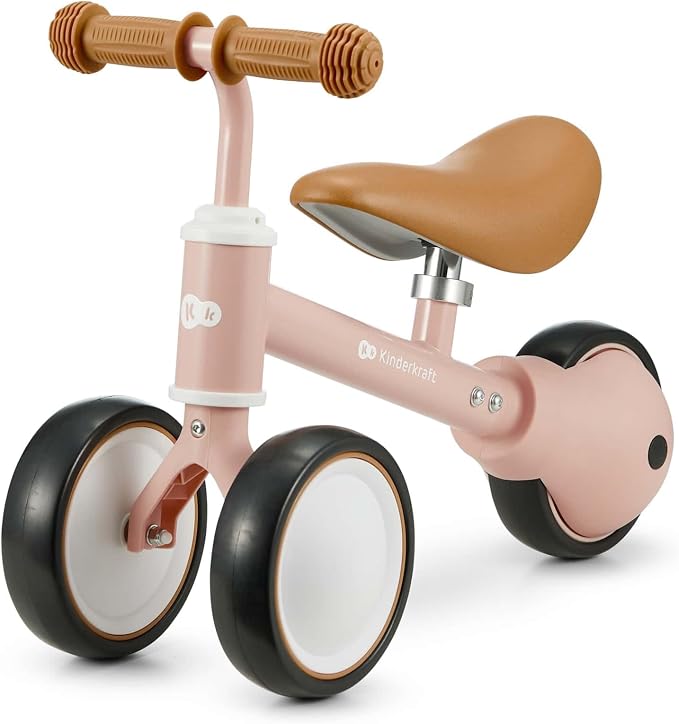
Kinderkraft Cutie
Four-wheel first step for cautious toddlers, not the direct prep choice for pedal-bike balance.
Kinderkraft Cutie is a 1.8 kg/4 lb stable-first ride-on for a child from about one year to 15 kg/33.1 lb, with a very low 26-28 cm/10.2-11 in saddle and a steering limiter. It fits early indoor and garden exploration better than a true two-wheel trainer; the three-wheel footprint and tiny adjustment range mean another bike will be needed for sustained gliding practice.
Pros
- The 26-28 cm/10.2-11 in saddle, 1.8 kg/4 lb frame and steering lock suit a small rider taking first seated pushes.
Cons
- Only 2 cm/0.8 in of saddle adjustment and the stable multi-wheel format limit both growth room and genuine two-wheel balance development.
- Rank #25 Our score: 9.64 / 10
Hello-5ive 14-Inch Balance Bike
Hello-5ive 14-Inch Balance Bike fills the gap for an older or taller beginner whose inseam matches the 41-51 cm/16.1-20.1 in saddle range. Pneumatic tyres and adjustable bars suit rougher parks better than small foam-wheel bikes, but the larger frame is a poor first fit if the child cannot stand over it with both feet planted.
Pros
- The 41-51 cm/16.1-20.1 in saddle and 61-67.5 cm/24-26.6 in handlebar ranges give meaningful growth room for riders who have outgrown most 30.5 cm/12 in bikes.
Cons
- The larger wheels and high starting saddle rule it out for many younger children; measure inseam and allow comfortable knee bend before shortlisting it.
- Rank #26 Our score: 9.64 / 10
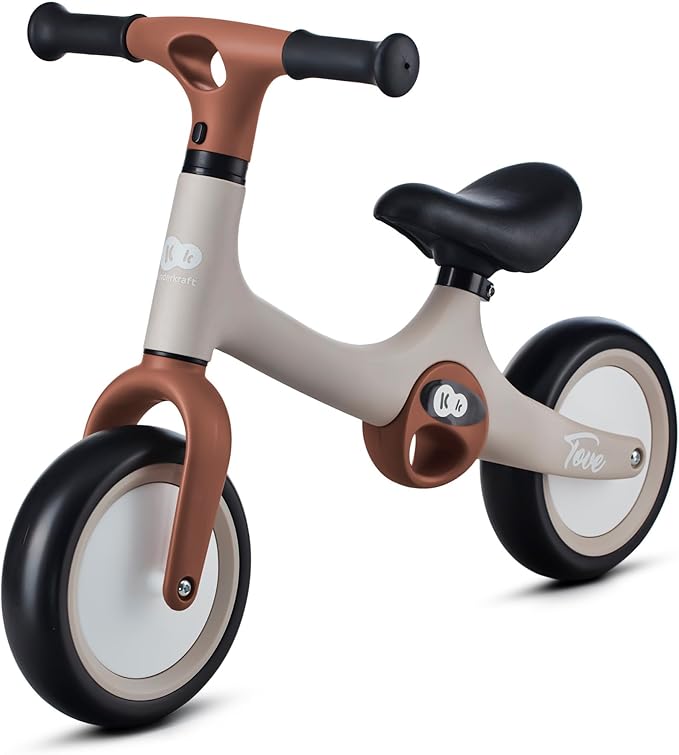
Kinderkraft TOVE balance bike
Kinderkraft TOVE suits a toddler who fits its 31-34.5 cm/12.2-13.6 in saddle range and is ready for a light two-wheel bike. Its 2 kg/4.4 lb frame is easy to carry and foam tyres avoid punctures, though they provide less cushioning than pneumatic tyres.
Pros
- At 2 kg/4.4 lb with two carry points, TOVE is manageable when a child stops riding halfway home.
Cons
- The short saddle adjustment range limits growing room, and foam tyres feel firmer than air tyres on rough paths.
- Rank #27 Our score: 9.64 / 10
Kinderkraft 2WAY NEXT OFF ROAD balance bike
The 2WAY NEXT OFF ROAD has a 32-41 cm/12.6-16.1 in saddle and a steel frame; the complete bike weighs 2.9 kg/6.3 lb, making it manageable to carry home after practice. Its treaded 30 cm/11.8 in EVA wheels need no pumping, but the OFF ROAD name should not suggest trail suspension: choose level paths and expect a firmer ride than air tyres provide.
Pros
- The 32-41 cm/12.6-16.1 in saddle range leaves room to grow, while the 2.9 kg/6.3 lb bike is manageable to carry after practice.
Cons
- Treaded EVA wheels remain firmer than air tyres on broken paths.
- Rank #28 Our score: 9.63 / 10
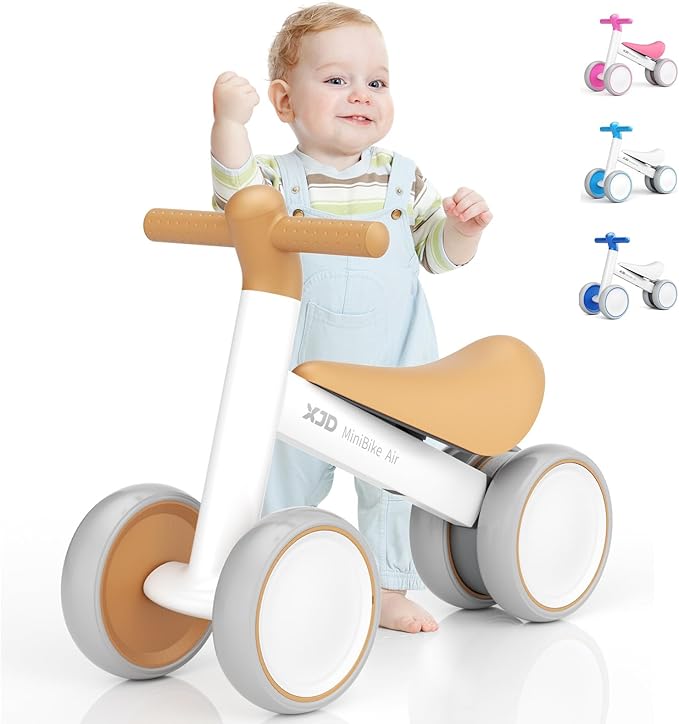
XJD Baby Balance Bike
XJD Baby Balance Bike is a low four-wheel starter for 10-24 month children, with a 20 cm/7.9 in seat height and enclosed EVA wheels. It is a confidence toy first, not a direct replacement for a later two-wheel balance bike.
Pros
- 10-24 month fit, low 20 cm/7.9 in seat, and four-wheel layout suit a very early rider who needs a stable first bike.
Cons
- Does not teach two-wheel lean and glide as directly as a classic balance bike.
- Rank #29 Our score: 9.60 / 10
Birtech 35.6 cm/14 in Magnesium Balance Bike
This 35.6 cm/14 in Birtech is a two-wheel balance bike with a magnesium-alloy frame and air-filled tyres. Birtech lists a 3.9 kg/8.6 lb weight and a 45-52 cm/17.7-20.5 in saddle range for ages 3–6. The pneumatic tyres add cushioning on mixed paths, though they need inflation checks; the maker does not list a brake, so confirm the current configuration and supervise early rides. At the 45 cm/17.7 in minimum saddle height, measure your child’s inseam and ensure both feet can reach the ground securely before buying.
Pros
- At 3.9 kg/8.6 lb, the magnesium-frame bike is manageable to lift; its 45-52 cm/17.7-20.5 in saddle and 62-67 cm/24.4-26.4 in handlebar ranges let families adjust the fit as a preschooler grows.
Cons
- Air-filled tyres need pressure checks and can puncture.
- Rank #30 Our score: 9.52 / 10
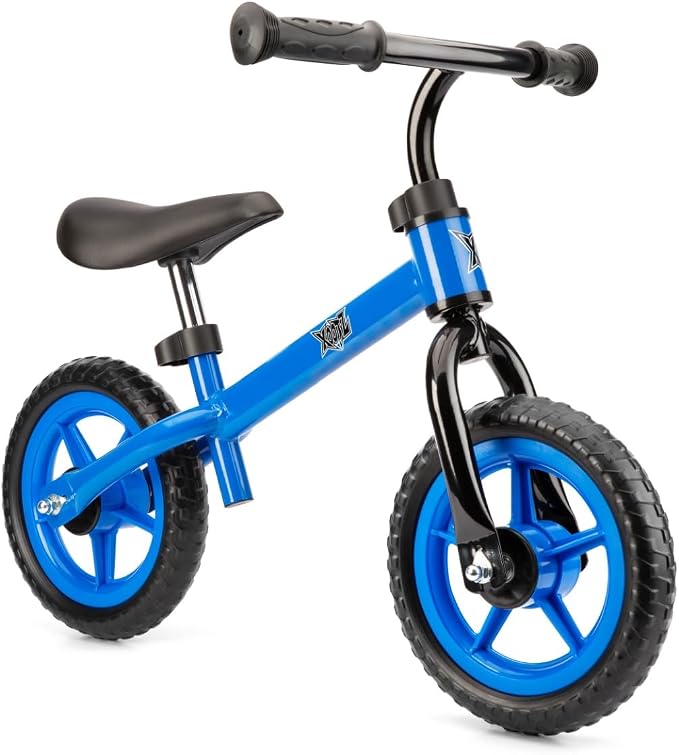
Xootz Balance Bike Blue
The Xootz TY5877 is a straightforward first balance bike with a steel frame and puncture-proof EVA tyres. The solid tyres avoid pumping and flats, but provide less cushioning than air tyres. The maker lists it from age two and up to 20 kg/44.1 lb, without a child height, inseam or saddle-height range, so check fit before buying rather than relying on age alone.
Pros
- The steel-framed TY5877 uses puncture-proof EVA tyres, avoiding both punctures and inflation checks on a child’s first balance-bike practice rides.
Cons
- The solid EVA tyres avoid flats but give less cushioning than air tyres; Xootz publishes no rider height, inseam or saddle-height range, so age 2+ alone cannot confirm fit.
- Rank #31 Our score: 9.46 / 10
Dromlag Balance Bike
Dromlag Balance Bike is the low-fuss smooth-surface option: a plain two-wheel learner with foam tyres for short practice runs. It belongs on the shortlist when you want simple upkeep, but it is weaker for rough park paths or uncertain fit.
Pros
- Simple preschool learner format avoids confusing extras.
Cons
- No strong brand geometry makes the fit check more important.
- Rank #32 Our score: 9.46 / 10
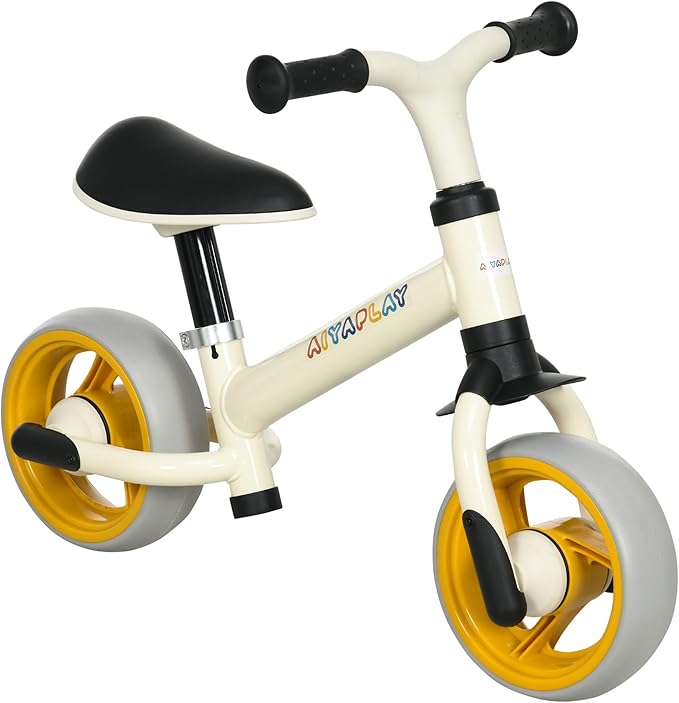
AIYAPLAY 8-inch Toddler Balance Bike
AIYAPLAY's 20.3 cm/8 in two-wheel model is a low toddler learner for ages roughly 18-48 months when its 25.5-32 cm/10-12.6 in saddle range fits now. It is more cycling-like than four-wheel baby ride-ons, but offers limited room for a taller preschooler.
Pros
- The very low published saddle range can suit a toddler who is too small for most 30.5 cm/12 in bikes.
Cons
- The compact frame and short saddle range leave limited growing room.
- Rank #33 Our score: 9.44 / 10
Bueuwe Large-Wheel Balance Bike
Best: Older child fit
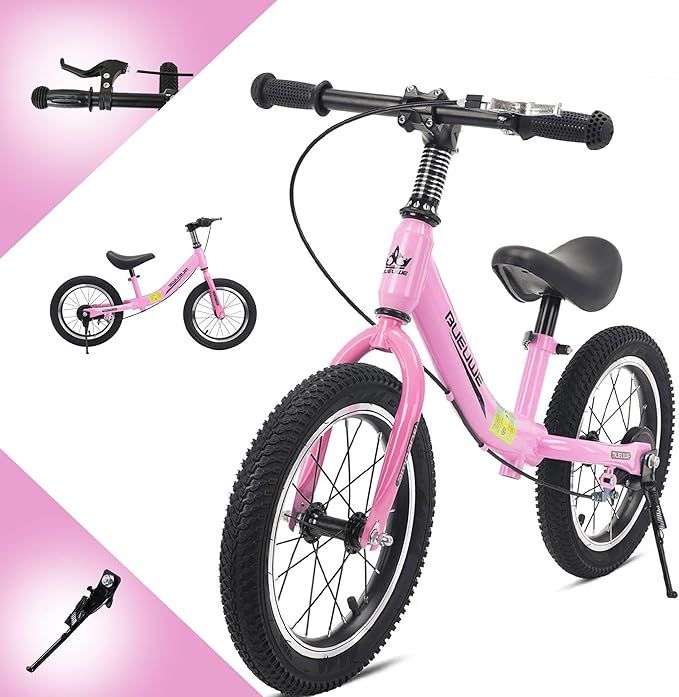
For a child whose first balance bike has become too small, the Bueuwe 14/40.6 cm/16 in listing gives an age range of 3–8, but frame fit matters more than the label. Check that the lowest saddle setting suits your child’s inseam and lets them put both feet down; also confirm they can reach and squeeze the brake to stop confidently.
Pros
- Larger no-pedal format can help children who have outgrown small toddler balance bikes.
Cons
- Too much bike for many early learners, so inseam and brake reach need checking.
- Rank #34 Our score: 9.43 / 10
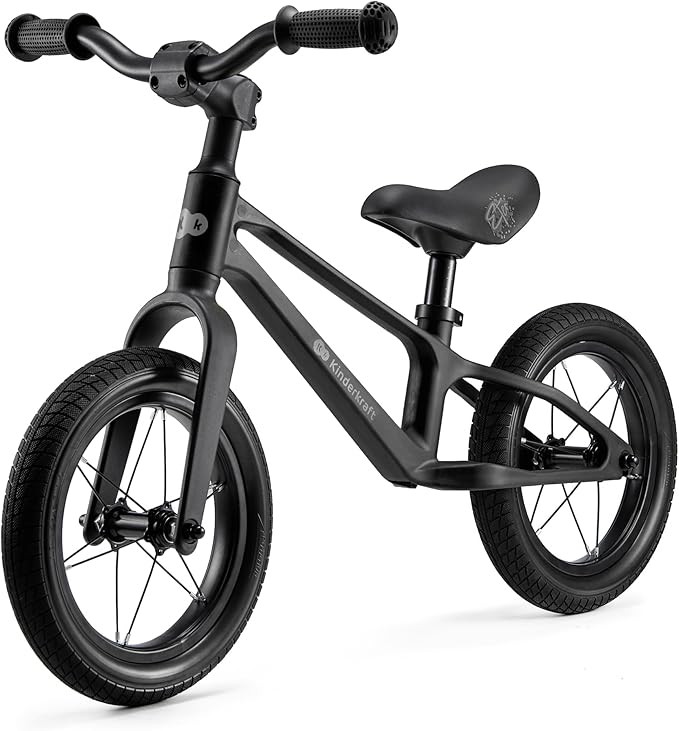
Kinderkraft ETER
Kinderkraft ETER is a 3 kg/6.6 lb, 12-inch balance bike for a child at least 80 cm/31.5 in tall who fits its relatively high 37-45 cm/14.6-17.7 in saddle range. Its PU wheels avoid puncture chores, while smaller toddlers should choose a lower starter rather than buy for future growth.
Pros
- The 37-45 cm/14.6-17.7 in saddle range gives taller preschoolers useful adjustment room.
Cons
- A 37 cm/14.6 in minimum saddle is too high for many early toddlers.
- Rank #35 Our score: 9.40 / 10
Braxel Balance Bike
Braxel Balance Bike is a basic 30.5 cm/12 in two-wheel learner for preschool practice on smoother routes. Adjustable saddle and handlebar help with growth, but measure the minimum saddle height and carrying weight because the broad age and 35 kg/77.2 lb limit do not establish a good fit.
Pros
- Adjustable saddle and handlebar provide useful room to tune preschool fit.
Cons
- The listing gives less transparent fit geometry than stronger documented alternatives.
- Rank #36 Our score: 9.38 / 10
Kinderkraft RAPID 2
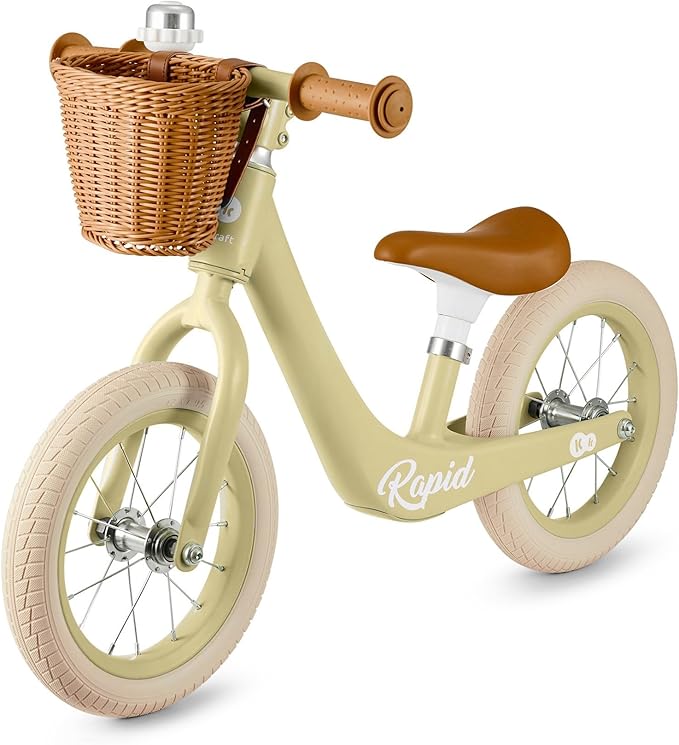
Kinderkraft RAPID 2 is a 30.5 cm/12 in air-tyre balance bike for a preschooler who fits its 33.4-41.3 cm/13.1-16.3 in saddle range and rides beyond smooth pavement. The basket and bell add utility, while the 3.7 kg/8.2 lb weight and tyre upkeep are the tradeoffs against lighter foam-wheel starters.
Pros
- Twelve-inch air tyres add cushioning on park paths and packed gravel.
Cons
- At 3.7 kg/8.2 lb it is less carry-friendly, and the air tyres need pressure checks and can puncture.
- Rank #37 Our score: 9.35 / 10
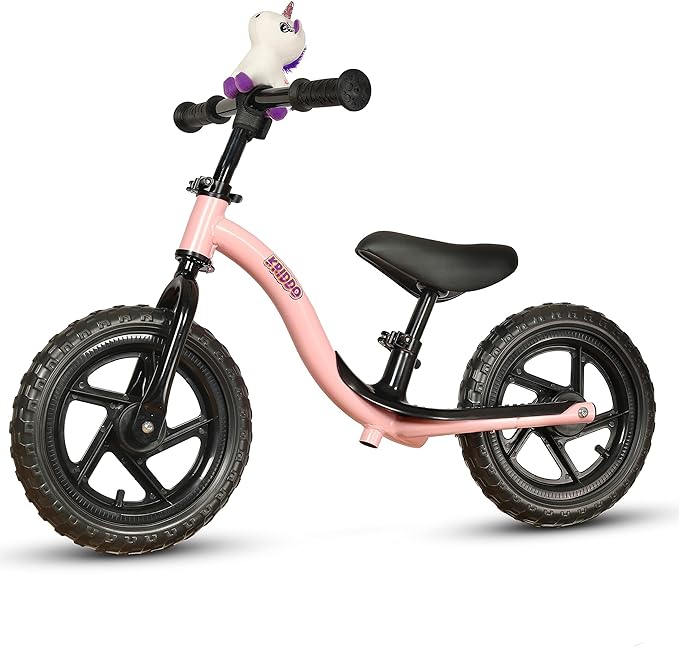
KRIDDO Riding Buddy
The pink Riding Buddy pairs a handlebar unicorn with a low frame and footrest for first pushing and gliding practice. Its saddle adjusts from about 30-43 cm/11.8-16.9 in; the KB001 manual specifies ages 2–5. There is no handbrake, and tyre construction remains unclear, so choose it for supervised, level-ground practice with both feet firmly on the ground.
Pros
- The low curved frame and roughly 30-43 cm/11.8-16.9 in saddle adjustment help a small rider get on and find a feet-flat position.
Cons
- Without a handbrake, stopping depends on the child's feet; slopes are outside the manual's intended use.
- Rank #38 Our score: 9.34 / 10
Hello-5ive balance bike with EVA wheels
Hello-5ive EVA-Tyre Balance Bike is a 30.5 cm/12 in option for a preschool rider whose inseam fits the 34-41 cm/13.4-16.1 in saddle. Its nylon frame and flat-free tyres keep handling and maintenance simple on smooth everyday routes; families using gravel, wet paths or kerbs should compare the grip and cushioning of air tyres.
Pros
- The 34-41 cm/13.4-16.1 in saddle and 54-60 cm/21.3-23.6 in handlebar provide concrete fit ranges rather than relying only on an age label.
Cons
- The 7 cm/2.8 in saddle range may be short-lived for a fast-growing child, and solid foam tyres trade away the cushioning and wet grip of pneumatic tyres.
- Rank #39 Our score: 9.33 / 10
BERG Biky Trail
BERG Biky Trail is a 30.5 cm/12 in air-tyre learner for a preschooler already riding fast enough to benefit from a hand brake and steering limiter. It brings more rough-path equipment than a basic starter, with extra fit and brake-reach checks in return.
Pros
- Air tyres, hand brake and controlled steering suit more confident park-path practice.
Cons
- The extra equipment is unnecessary for a hesitant child just learning to scoot.
- Rank #40 Our score: 9.33 / 10
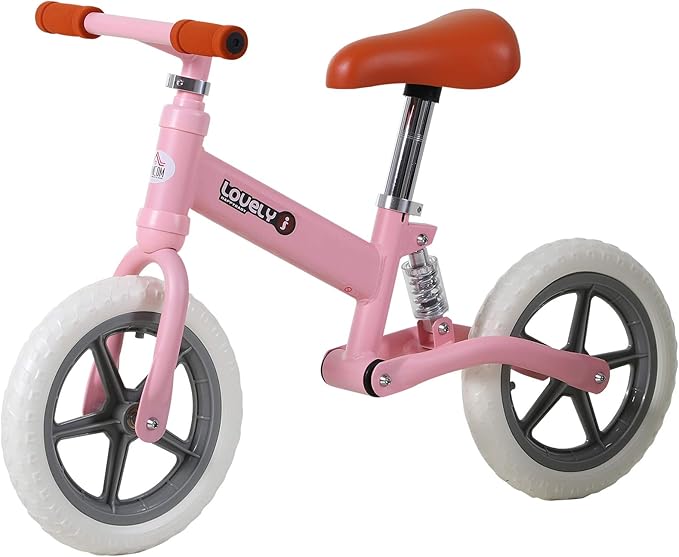
HOMCOM 12 Inch Balance Bike
HOMCOM 12 Inch Balance Bike is a two-wheel toddler learner for families who want a straightforward first bike with an adjustable seat. It is best for basic park and pavement practice rather than rougher riding.
Pros
- Simple 30.5 cm/12 in two-wheel format keeps the learning focused on balance and steering.
Cons
- Best kept to smoother routes rather than rough ground.
- Rank #41 Our score: 9.33 / 10
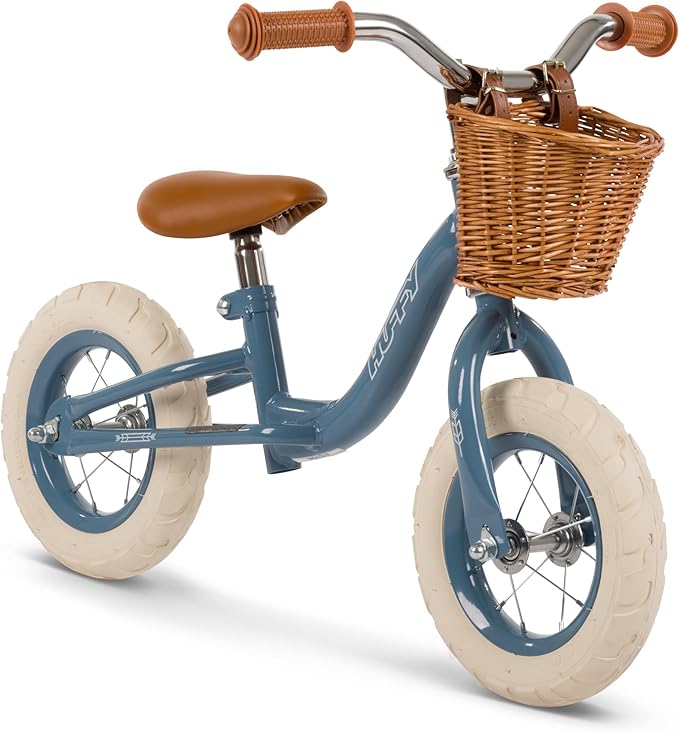
Huffy Vintage 10-Inch Balance Bike
Huffy Vintage 10″ combines a low step-through frame with a basket for a favourite toy on early practice rides. Air-filled tyres and a steel frame make a small, traditional first bike, with tyre-pressure checks part of the upkeep. There is no handbrake: secure, flat-footed ground contact is essential for stopping.
Pros
- The low frame eases stepping aboard, and a seat-post binder bolt lets you adjust saddle height.
Cons
- Huffy publishes no saddle-height range, so the small wheels alone cannot establish whether a short-legged child will fit.
- Rank #42 Our score: 9.33 / 10
H.yeed 12-inch Balance Bike
H.yeed's 12-inch balance bike suits a child whose inside leg works with its 34-41 cm/13.4-16.1 in saddle range. At about 2.1 kg/4.6 lb it is easy to carry and the foam tyres need no pumping, but they feel firmer on broken paths and the 34 cm/13.4 in minimum still rules out some younger toddlers.
Pros
- The 2.1 kg/4.6 lb frame is unusually manageable when a parent must carry it, and the published adjustment ranges make fit checkable.
Cons
- Foam tyres trade puncture-free convenience for a firmer ride, and the 34 cm/13.4 in saddle minimum needs an inside-leg check.