Best Child Bike Seats in Japan 2026
The best child bike seats for families who want a lighter, narrower, and simpler cycling setup than a trailer, but still need the right mount style, child position, and day-to-day fit for real rides.
Why are scores between 9 and 10?
This is a curated shortlist of strong picks, not a full best-to-worst ranking. Small score gaps usually mean we have slightly more evidence for one model than another, not that the lower-scoring option is a poor choice.
So this is just another affiliate roundup with an arbitrary order?
No. We make these lists good enough that we use them ourselves and recommend them to friends and family. We turn the kind of research careful parents would normally do by hand into a repeatable process. Then we compare the evidence across the markets we cover and rank products with a model that gives more weight to stronger signals instead of simple averages or a fully hand-picked order based purely on editorial preference.
Affiliate Disclosure
We use affiliate links and ads to finance this website. As an Amazon Associate I earn from qualifying purchases.
- Rank #1 Our score: 9.79 / 10
UrRider
Best: Affordable
UrRider is a front-mounted option for families who want a more interactive ride position on compatible bikes. It needs a stricter cockpit and frame-fit check than a conventional Japanese rear seat, so it belongs as a niche choice rather than the default.
Pros
- The close front position suits short rides where talking with the child is part of the reason to choose the seat.
Cons
- Frame and cockpit compatibility decide whether it works, so it is risky without a careful fit check.
- Rank #2 Our score: 9.72 / 10
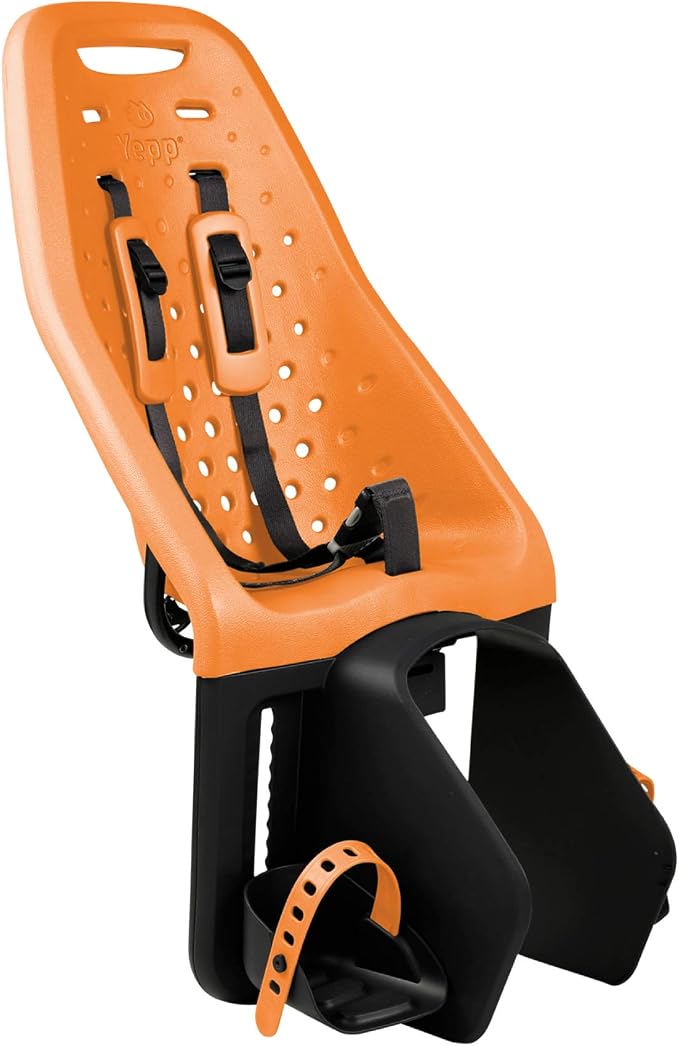
Thule Yepp Maxi EasyFit
Best: Rear-mounted
Thule Yepp Maxi EasyFit keeps the handlebar area clear by mounting behind the rider on an EasyFit-compatible carrier. Consider it from age 3 up to the sixth birthday, within 9-22 kg. The carrier must meet ISO 11243 and be rated for at least 25 kg; an ordinary rear rack alone is not enough.
Pros
- The rear position leaves the handlebar area clear while carrying a child up to 22 kg.
Cons
- A standard rear rack is not enough: the seat needs an EasyFit interface on a carrier rated for at least 25 kg and compliant with ISO 11243.
- Rank #3 Our score: 9.70 / 10
OGK RBC-015DX Casual Rear Kids Seat
A rear rack-mounted seat with headrest for families who want a straightforward Japanese city-bike setup. It is the practical OGK option when compatibility with a proper rear carrier matters more than premium padding.
Pros
- A rear-rack OGK seat with head support gives a practical step up from very basic rear seats.
Cons
- The rack class and width limits matter; uncertain carrier fit should stop the purchase.
- Rank #4 Our score: 9.70 / 10
OGK FBC-011DX3 Comfort Front Baby Seat
Best: Mid-range
A front-mounted OGK seat for parents who want their younger passenger in view on short nursery runs. The key pre-buy check is stem and bike compatibility, because front seats are less universal than rear rack seats.
Pros
- More head and foot support make it a stronger front-seat pick than the simplest OGK options.
Cons
- It still needs a compatible front mounting area; not every city bike will feel roomy.
- Rank #5 Our score: 9.64 / 10
OGK RBC-011DX5 Rear Child Seat
The OGK RBC-011DX5 is a rear child seat for maker-approved city bikes with 50.8 cm or larger wheels and bikes approved for carrying two children with a class 27 or higher rear carrier. The carrier must be 120–175 mm wide, and the bike must have a locking double-leg stand and dress guard. OGK allows children from age one until school entry, up to 120 cm; it recommends riding from age two. The weight ceiling is 22.6 kg on a class 27 carrier. With a higher-rated carrier, the child limit is the carrier class minus the seat's 4.4 kg, capped at 24 kg. Choose it only when the bicycle maker permits this seat and the carrier meets those limits.
Pros
- Movable headrest, five-point belt, and four-position footrests give useful adjustment for a growing child within OGK's limits.
Cons
- Carrier class sets the weight ceiling, and a 120–175 mm class 27+ carrier, locking double-leg stand, dress guard, and bicycle-maker approval are required.
- Rank #6 Our score: 9.60 / 10
OGK FBC-003S Front Child Seat
FBC-003S is the simpler front-seat option for short trips with a smaller child, especially when price and a compact front setup matter. It gives up the fuller headrest feel of OGK’s comfort front seats, so fit and child support matter more.
Pros
- A simple front-mounted OGK seat keeps parent-child visibility high for short local rides.
Cons
- Front mounting means handlebar space and rider knee clearance need checking.
- Rank #7 Our score: 9.58 / 10
Silla infantil delantera Urban Iki
Urban Iki EFBC-001 keeps a small child in view with a five-point harness and adjustable foot support. Its front-seat stage is short: 9 months to under 4 years, within 9-15 kg. The compact adapter needs a 22–28 mm stem with at least 19 mm of mounting space, so bicycle fit comes before convenience.
Pros
- The front position keeps the child visible, with a five-point harness and adjustable foot trays and straps.
Cons
- Its 15 kg limit and under-four age boundary leave a shorter use window than a larger rear seat.
- Rank #8 Our score: 9.33 / 10
OGK FBC-015DX Front Child Seat
The FBC-015DX is a front seat for a younger child on a compatible city bike, keeping the child in view on short nursery or park trips. OGK limits it to ages 1 to under 4, up to 15 kg and 100 cm, on 61-68.6 cm city bikes with a double-leg stand. Its handlebar-post mount is for 22.2 mm posts; frame or handlebar shapes can still prevent installation. Choose it when your bike and child both fall inside those limits and you value a front position. It is a poor fit for older or taller children, and the seat should not be bought on the assumption that every electric-assist bike can take it.
Pros
- The front position keeps a young passenger visible and within easy conversation on short local rides; OGK specifies a five-point belt and adjustable footrests.
Cons
- This is a narrow stage and bike fit: under age 4, at most 15 kg/100 cm, and 61-68.6 cm city bikes with a 22.2 mm handlebar post; unusual shapes may not fit.
- Rank #9 Our score: 9.33 / 10
OGK Grandia FBC-017DX3 Front Child Seat
Best: E-bike compatible
OGK Grandia FBC-017DX3 is the front seat to compare when a 1-to-under-4-year-old needs more head-and-foot enclosure and the adult wants the child in view. It is limited to 15 kg and 100 cm, and the bicycle must meet OGK’s handlebar, post, frame, stand and maker-approval conditions; measure the actual bike before choosing it.
Pros
- Surrounding head and foot guards plus a self-retracting belt provide a more enclosed front-seat setup than open-perch designs.
Cons
- The 15 kg, 100 cm and under-4 limits make this a shorter-stage choice than a rear seat.
- Rank #10 Our score: 9.33 / 10
OGK Grandia Zero Plus RBC-017DX
Best: Premium
Grandia Zero Plus is the OGK rear seat to shortlist when side and head protection are the reason to pay more. It is a stronger safety-focused daily-commute option, but only after confirming the bike has a compatible class-rated rear carrier.
Pros
- The high-support rear shell is useful for regular nursery rides where stability matters.
Cons
- It is a larger rear seat, so rack compatibility and parking clearance are essential checks.
- Rank #11 Our score: 9.33 / 10
OGK Popola More RBC-019DX
Popola More is the rear OGK choice for families who want a headrest-equipped daily seat without moving to the Grandia safety flagship. It fits best when you want a familiar rear-child-seat layout for routine errands and nursery travel.
Pros
- A balanced rear-seat option when you want more support than a basic seat without the largest shell.
Cons
- It still depends on rear-carrier fit; do not buy before checking rack class and width.
- Rank #12 Our score: 9.33 / 10
OGK Popola RBC-019 / RBC-019S Rear Child Seat
OGK Popola RBC-019/RBC-019S is the lighter, basic rear-rack choice for families who want a simple daily seat and occasional basket function rather than the Popola More’s headrest. Check the exact model suffix before buying: the listing spans revisions, and the child limit, rack class, 120–175 mm rack fit, double-leg stand and dress-guard requirements must all match the bicycle and manual.
Pros
- A lighter rear seat with tool-free two-position footrest adjustment and a fold-out basket function when the child is not riding.
Cons
- The basic Popola uses a 3-point belt and has no headrest, so compare the Popola More if upper-body enclosure matters.
- Rank #13 Our score: 9.33 / 10
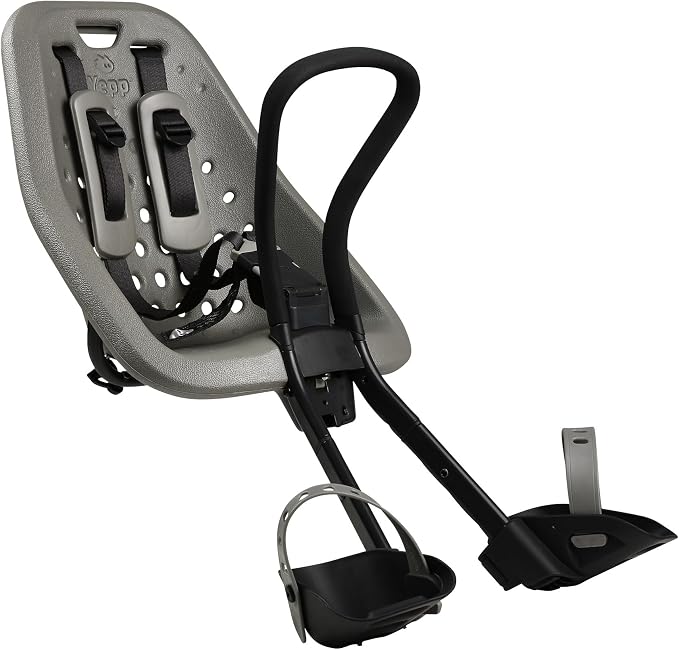
Thule Yepp Mini
Thule Yepp Mini puts a small child in front of the rider, with a padded five-point harness and adjustable footrests. Shortlist it for the 12–36-month, 9-15 kg stage. Its standard adapter needs a circular 20–28 mm stem and at least 21 mm of mounting space; steering and knee clearance can rule it out even when the stem fits.
Pros
- The front position keeps a young child in view, while the padded five-point harness and adjustable footrests provide a defined fit.
Cons
- The recommended 12–36-month, 9-15 kg stage is short, so this is not a seat to keep through the preschool years.