
Bike Trailer vs Rear Bike Seat: Which Should You Choose?
By Peter CronaUpdated
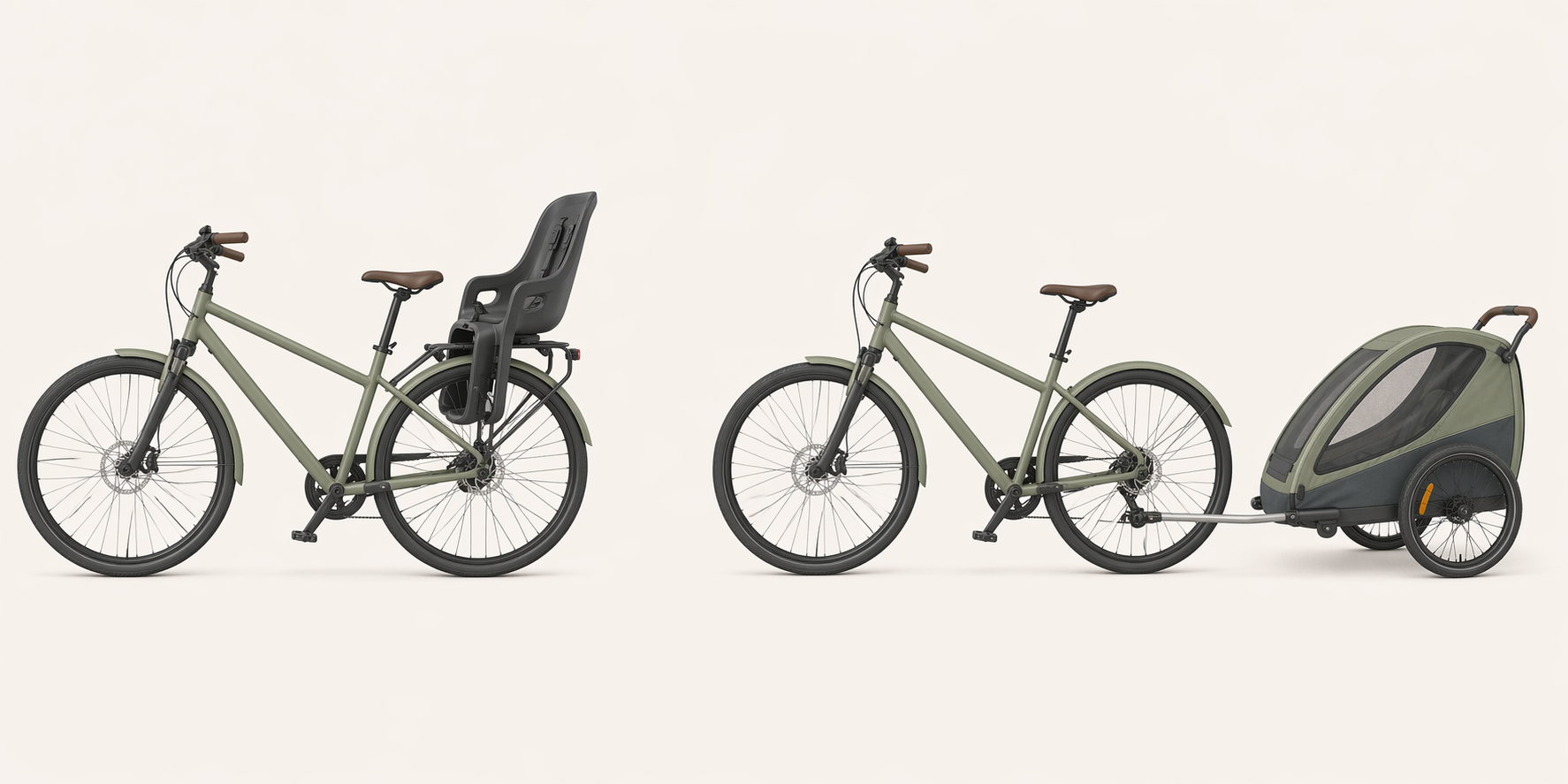
Parents usually do not need a more detailed bike-trailer feature list first. They need a clearer answer to a simpler question: will family cycling be easier with a trailer behind the bike, or with one child in a rear-mounted seat on the bike itself?
Choose a rear bike seat when you usually carry one child on short daily rides, need the narrowest and cheapest setup, and can tolerate the extra weight on the bike. Choose a trailer when you want more weather cover, nap comfort, cargo room, or space for two children, and you can live with more width, storage bulk, and towing effort.
Start with the ride you are trying to make easier
The useful version of this decision is not “Which product category is best?” It is “Which setup removes the most friction from the rides we actually do?”
Think about which of these sounds most like your real week:
- one child who already fits a rear seat and short nursery or school runs
- one child and calmer weekend leisure rides on traffic-free paths
- two children plus jackets, snacks, or groceries
- one child in a city routine with stairs, narrow barriers, and awkward storage
Those scenarios do not lead to the same answer.
This page compares a trailer with a rear-mounted child seat. Front-mounted seats are a narrower subcase and not the main decision here.
When a rear bike seat is the better answer
A rear bike seat is often the smarter buy when the problem is daily access, not family-cycling comfort.
It usually wins when:
- you mostly carry one child
- your rides are shorter and more stop-start than long and leisurely
- you need the narrowest setup for doors, barriers, sheds, or bike parking
- you have limited hallway, garage, or boot space
- you want the cheaper and simpler path for this stage
A rear seat makes quick in-and-out trips easier. It is also easier to live with if you carry the bike up stairs, store it in a small flat, or regularly pass through places where trailer width would annoy you every single day.
That strength has a limit. The child is more exposed to wind and drizzle, you get less room for bags, and the extra passenger weight changes bike balance and braking more directly. Rear seats also have their own bike-fit reality: frame shape, rack limits, and mounting style can rule a seat in or out faster than a product page suggests. Once rides get longer, calmer, or gear-heavier, the simple solution can start feeling like the tiring one.
When a bike trailer is the better answer
A trailer becomes the stronger answer when comfort, cover, and family hauling matter more than minimal size.
It usually wins when:
- you want to carry two children
- one child is likely to nap, get cold, or need a calmer place to sit
- you want room for jackets, groceries, or outing gear
- you prefer the child weight lower and more separate from the bike itself
- you expect more leisure rides than short urban hops
Cycling UK’s family transport guide, Cycling UK’s trailer guide, and REI’s buying guide all point in roughly the same direction here: trailers get more convincing when you care about lower center of gravity, weather cover, cargo room, and longer calmer rides.
That does not make trailers friction-free. They are wider, bulkier to store, and more awkward when your daily route includes bollards, tight turns, steep starts, or repeated stop-start traffic. Towing effort is real, especially on hills or rougher surfaces.
Which is safer, and what actually changes the answer
This is not a good category for a fake universal winner.
HealthyChildren’s guidance from the American Academy of Pediatrics says a child passenger on an adult bike makes the bike less stable and increases braking time, and it says trailers are preferable to bike-mounted seats. That is an important safety signal, and parents should take it seriously.
But it still does not settle every real-world purchase by itself.
Route choice, traffic exposure, trailer width, rider confidence, installation quality, and compatibility still matter. A trailer may look better on paper and still be the wrong daily tool if your normal ride involves narrow barriers, awkward road positioning, or storage friction so high that you stop using it.
Neither option fixes a route that already feels too traffic-heavy, too narrow, or too stressful for the adult rider. If your real problem is the route itself, the right answer may be to change the route, wait, or use a different family-transport plan.
The conservative boundary is simple:
- do not shop this by age alone
- the child should be able to sit well unsupported
- if the child is too small for a correctly fitting approved bike helmet, the child is too small for this decision
- the exact seat or trailer manual and local rules may set stricter limits than a generic article does
HealthyChildren’s helmet guidance is useful here because it keeps the helmet question practical: correct fit matters, and a loose helmet is not a real solution.
The everyday friction checklist that usually decides it
If you are still torn, this is usually the section that breaks the tie.
Choose the rear seat side if the bigger problem is:
- getting through tighter spaces without thinking about trailer width
- carrying the bike up stairs or storing it in a cramped hallway
- doing short daily rides where setup simplicity matters more than passenger comfort
- keeping cost lower because this is a short-stage purchase
Choose the trailer side if the bigger problem is:
- keeping one or two children warmer, calmer, and better sheltered
- making longer rides easier for a child who may nap or get tired
- carrying bags and child gear without giving up bike handling space
- moving child weight lower instead of loading more weight directly onto the bike
Also ask which kind of annoyance you would rather live with:
- more balance change on the bike itself
- or more trailer width and towing bulk behind it
That tradeoff matters more than abstract feature count.
Common mistakes
The usual bad buys happen for predictable reasons:
- shopping by age alone instead of by child stability, helmet readiness, and manual limits
- buying a trailer for a tiny home and a narrow daily route because it sounds safer in theory
- buying a rear seat for long windy rides because it looks simpler at checkout
- treating future-proofing as the main reason to buy instead of the next 1 to 2 years of real use
- assuming every bike takes every rear seat or trailer without compatibility checks
The best first buy is usually the one that solves your next ordinary year, not the one that sounds most versatile in an imaginary future.
What to do next
If trailer logic wins, go next to Bike Trailers 101: Where to Start and then to our best bike trailers shortlist.
If your real question has now become “single or double?” or “bike-only or pushchair-conversion?”, the hub is the right next page.
If the rear-seat side wins, that is still a good outcome. A simpler, narrower, cheaper setup can be the right answer for this stage, even on a site that also covers trailers.
If neither side feels honest for your home, route, or confidence level, that is useful too. “Not yet” is better than forcing a setup that makes you ride less.