
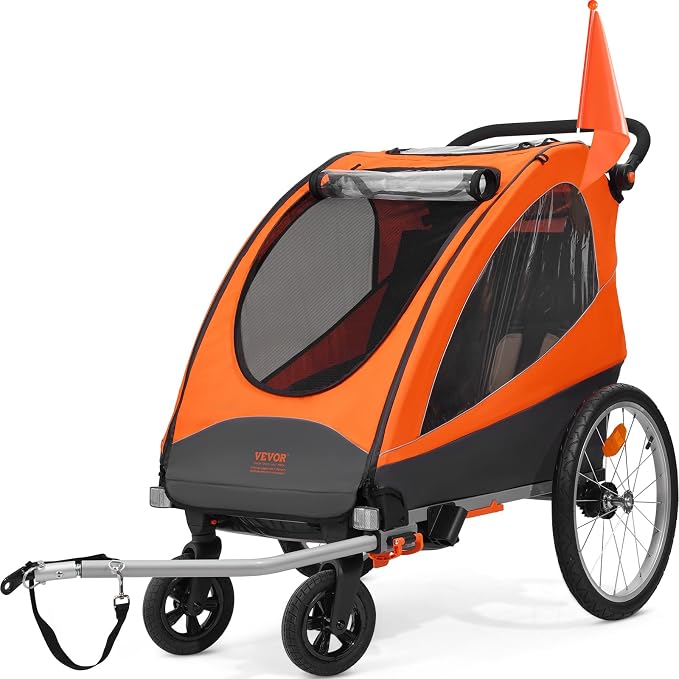
VEVOR JBT03K2 Aluminum Double Trailer and Stroller
Pros / Cons
Pros
- Two removable front wheels and a side towbar holder support the change from cycling to walking.
- The backrest can be adjusted within the supported seated child use.
Cons
- Both front wheels must come off before towing, adding a conversion step to mixed outings.
- Aluminium does not make this a particularly light lift: its selected specification gives 15.2 kg/33.5 lb product mass.
Product Facts
- Max Load
- 45.4 kg/100 lb
- Seats
- 2
- Use
- Stroller conversion
- Product page
- Open product page
- Price/Buy
- Check price at Amazon
Two walking wheels and a place for the towbar
The aluminium JBT03K2 adds two removable front wheels and a side towbar holder to its double cabin. Those details are useful when a ride ends with a walk: the towbar has a designated place instead of being carried separately. Both front wheels must be removed before towing again.
The adjustable backrest is a comfort adjustment, not approval for an infant or a sleeping position. Its two five-point harnesses must fit children within the selected 18 months–5 years range. The manual mentions 12 months with independent sitting and head control, but that earlier wording does not override the selected chart. Maximum load is 22.7 kg/50 lb per child and 45.4 kg/100 lb for children and luggage combined.
Allow time for conversion checks
After changing modes, check the towbar’s blue clamp and locking bolt and pull on the assembled rear wheels to confirm engagement. For bicycle use, the supplied quick-release/nutted-axle hitch requires at least five full nut-thread turns and the secondary frame strap; it is not a thru-axle hitch. The selected chart lists 55.9-71.1 cm/22-28 in bicycle wheels, which is only one part of compatibility.
The brake holds the trailer stationary. It is not a running brake, and neither running nor motorized towing is permitted. Keep towing to 10 mph, about 16 km/h, or slower for the conditions.