
Are Baby Carriers Worth It for Everyday Family Life?
By Peter CronaLast updated Last checked
The useful question is not whether a baby carrier is always better than a stroller. It is not. The better question is where a carrier solves a problem that a stroller cannot solve cleanly: airport transfers, stairs, crowded public transport, hiking paths, older siblings, and babies who only settle when they are held close.
A baby carrier is worth it if it solves a specific daily problem: a newborn who needs contact naps, a baby who wants to look around while you keep both hands free, a toddler who still needs carrying on transfers, or family outings where a stroller becomes awkward. It is less convincing as a vague “must-have” if your baby sleeps well in a stroller, your routes are flat and accessible, and no adult in the household actually finds carrying comfortable.
That is why my family’s carrier use changed so much between two children. With my son, the carrier sat unused for long stretches because the stroller covered most everyday outings. It became useful later, when we started traveling more, planned walks and hikes where a stroller was not the obvious answer, and had to move through public transport with luggage. With my daughter, the carrier became useful much earlier because she slept much better when carried close.
First child: the carrier waited until travel
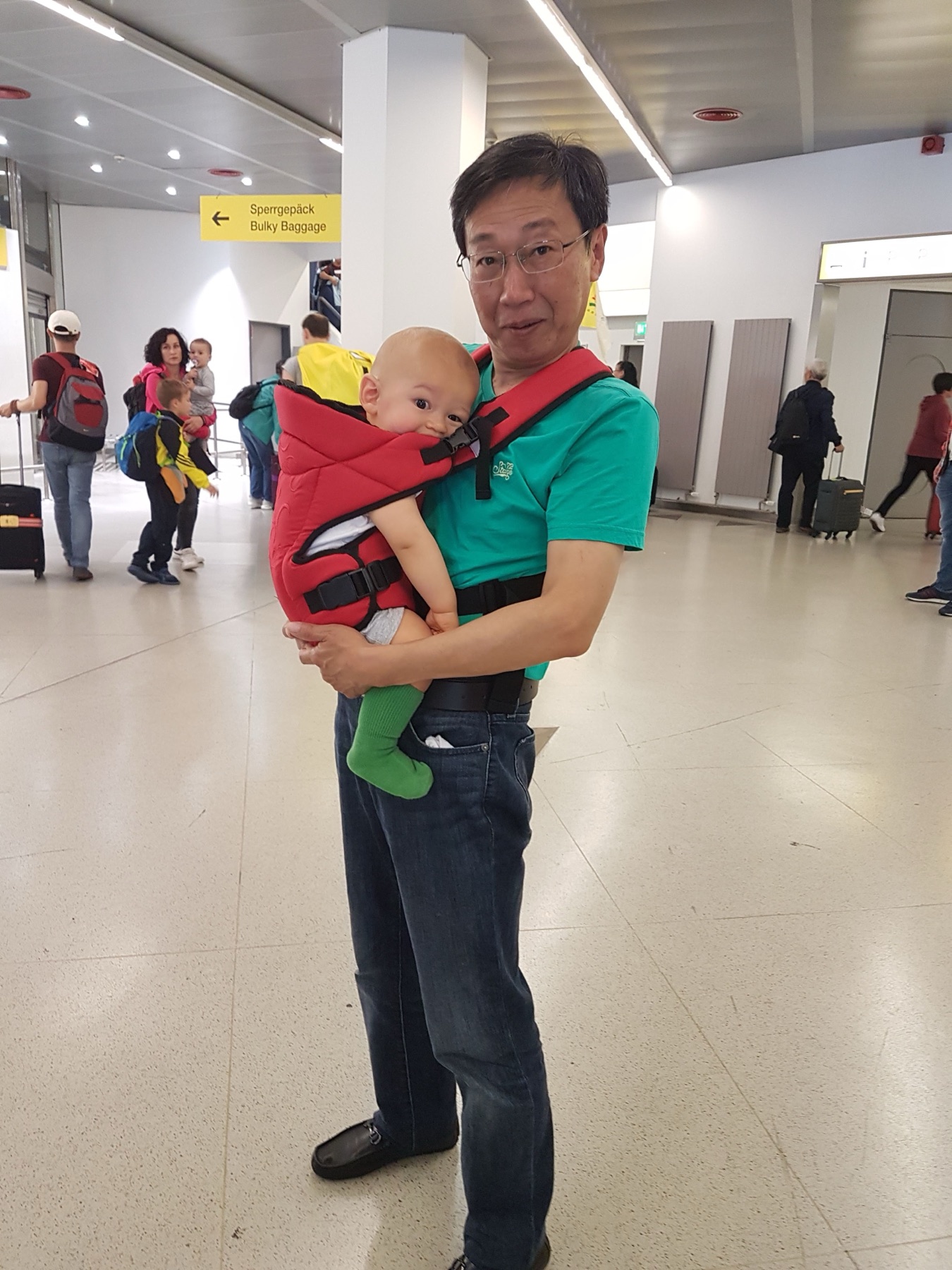
Our first carrier was a red soft structured carrier from a small Polish brand. I do not know the exact model now, and I would not recommend buying an unknown carrier by memory or appearance alone. At the time, it did not feel like the right tool for the earliest newborn stage, and our routine did not force the issue. We mostly used the stroller, so the carrier waited.
Then travel changed the calculation. My son was about one year old when we used the carrier after landing in Spain, and that was the first time I really understood its job.
At an airport, the stroller and the carrier solve different problems. A stroller gives the child a place to sit and can carry bags, but it also becomes another item to steer, fold, wait for, or lift through the awkward parts of the journey. A carrier gives up the storage, but it keeps the child attached to an adult while the adult still has both hands available.
That difference matters most in transitions: getting off the plane, collecting luggage, finding the next sign, using toilets, handling stairs or escalators, and keeping the group moving when everyone is tired. The carrier was not better than the stroller for every part of the trip. It was better for the moments when pushing a stroller would have become another task.
Toddler travel: the carrier saved space
Public transport made the same lesson more concrete when my son was closer to two. On the way to the airport, I could carry him in the carrier while also managing luggage and the normal small tasks of traveling.
For a bigger baby or young toddler, the carrier is rarely about replacing walking all day. It is about having a backup that does not occupy floor space. With a stroller, the whole trip depends on the available space: the lift, the aisle, the door area, the luggage corner, the other passengers. With a carrier, the child uses the space the adult is already using.
That matters because daily family movement often mixes walking, transit, stairs, elevators, errands, and awkward transfers. A stroller still has a place, especially for long days and storage. But the carrier is the smaller tool that makes unpredictable segments easier.

The nap part is individual. My son was an easy baby and did not need the carrier much for sleep at home. But on a crowded transport day, the carrier let him sleep while I stayed standing, balanced, and able to move with the bags. That is a very different kind of usefulness from a calm stroller nap on a wide sidewalk.
Second child: the carrier became a sleep tool
With my daughter, the carrier became useful for a different reason: sleep. She was much harder to settle, and the carrier gave her longer contact naps than we could reliably get elsewhere. Once we noticed that pattern, we bought a secondhand older structured carrier with a separate infant insert for the newborn stage.
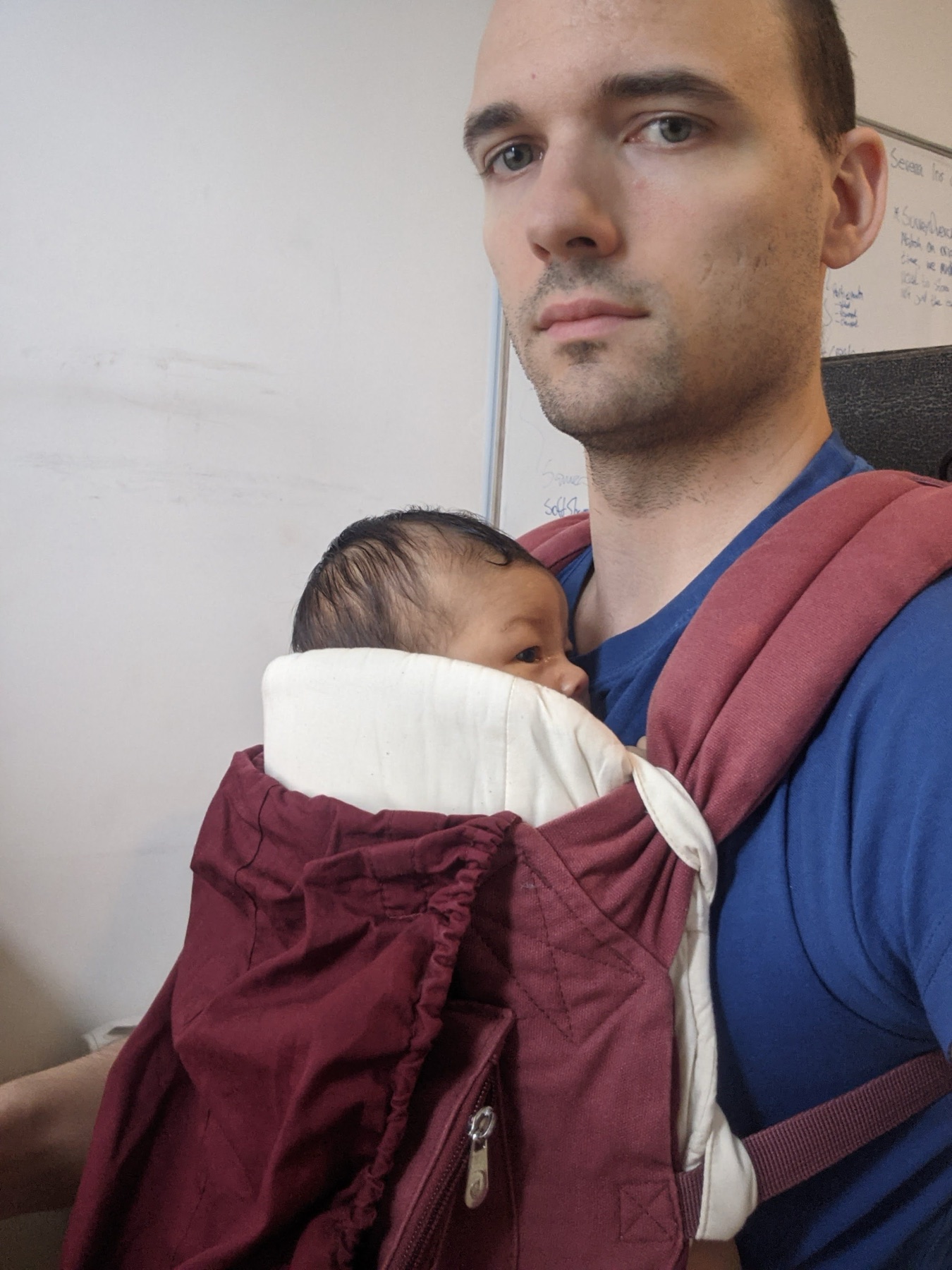
A note on the carrier shown here: I cannot verify the exact brand from these photos because the logo is not visible. It looks like the older class of soft structured carriers that used a separate infant insert, and older Ergobaby Original-style setups are one familiar example of that category. For accuracy, I treat it here as an older structured carrier used with an infant insert, not as a confirmed product ID.
That distinction matters. Newborn carrying is not just “carrier yes or no.” It is whether this exact carrier, insert, baby size, adult body, and adjustment method produce a safe, repeatable fit. For newborns, the baby should stay upright, close, visible, and supported. The face should stay easy to monitor, the chin should not be pressed down onto the chest, and the carrier should support the body without letting the baby slump.
The International Hip Dysplasia Institute babywearing guidance is also a useful reference for lower-body support. It does not replace the product manual, but it explains why supported positioning matters, especially early on.
Older baby stage: easier fit, more awareness
As my daughter grew, the same carrier became simpler to use. You are still checking fit, but you are no longer dealing with the same newborn-insert puzzle, and the baby can participate in the outing instead of only being tucked in close.

This is when the carrier started feeling less like emergency gear and more like an everyday option. She could look around, and I could carry a bag, open doors, take public transport, or walk through places where pushing a stroller would have been annoying.

The tradeoff is heat and adult comfort. A carrier that feels fine for ten minutes indoors can feel too warm or heavy on a longer summer walk. If you expect frequent long carries, do not treat padding, waistband fit, strap adjustment, and fabric weight as minor details.
The hidden value with two children
The strongest carrier argument is often not the baby alone. It is the whole family layout, especially once there are two children.

With two children, a carrier can turn an awkward body-management problem into a workable one. One child can be close and contained while the older child walks, rides shoulders for a short stretch, or needs help. That does not mean carrying two children like this should be your plan for every outing. It means the carrier can keep a day from falling apart when one adult has to manage more than one need at once.
This is especially useful in places where a stroller is technically possible but practically irritating: farms, markets, older streets, crowded indoor attractions, stairs, narrow shops, or short outings where bringing a stroller feels like too much equipment.
When the stroller is still the better tool
A carrier is not a stroller replacement for every family. A stroller usually wins when:
- you need storage for food, diapers, jackets, and shopping
- the child will nap better lying down in a stroller
- the adult has back, pelvic-floor, shoulder, or recovery issues
- the weather is hot enough that body-to-body carrying becomes uncomfortable
- the outing is long, flat, and stroller-friendly
- the child is in a constant up-down-up-down phase and the carrier becomes annoying
This is why “buy a carrier instead of a stroller” is usually too simplistic. Most families who use both are not duplicating gear. They are solving different types of friction.
What to check before buying one
Start with the job, then choose the carrier. The wrong order leads to expensive gear that stays in the closet.
Ask:
- Are you solving newborn contact naps, public transport, travel, stairs, or toddler backup?
- Does the carrier truly fit the baby’s current stage, not just a future stage?
- Can the main adult put it on correctly without help?
- If two adults will use it, is adjustment quick enough that both will actually bother?
- Will it be too warm for your normal season and route?
- If buying secondhand, can you find the manual, inspect buckles and stitching, and confirm the exact model’s age, weight, and carry-position rules?
The secondhand point is important. A used carrier can be a smart buy, especially when you are testing whether babywearing will actually help your family. But it should still be identifiable, intact, and used according to its own instructions.
Our practical rule
For our family, the carrier was not equally useful at every stage. With my son, it was underused early, then became a travel, hiking, airport, and public-transport tool. With my daughter, it became a sleep and two-child-outing tool much earlier. That is the real answer: a carrier is worth it when it solves the actual friction in front of you, not when it wins an abstract gear debate.
If you are still choosing the type, start with Baby Carriers 101: Where to Start. If you are choosing specifically for the early months, read Best Baby Carrier for a Newborn: Structured Carrier, Wrap, or Ring Sling?. Once the use case is clear, compare models on our best baby carriers shortlist.