
What Makes a Stroller Work Well in Sweden?
By Peter CronaLast updated
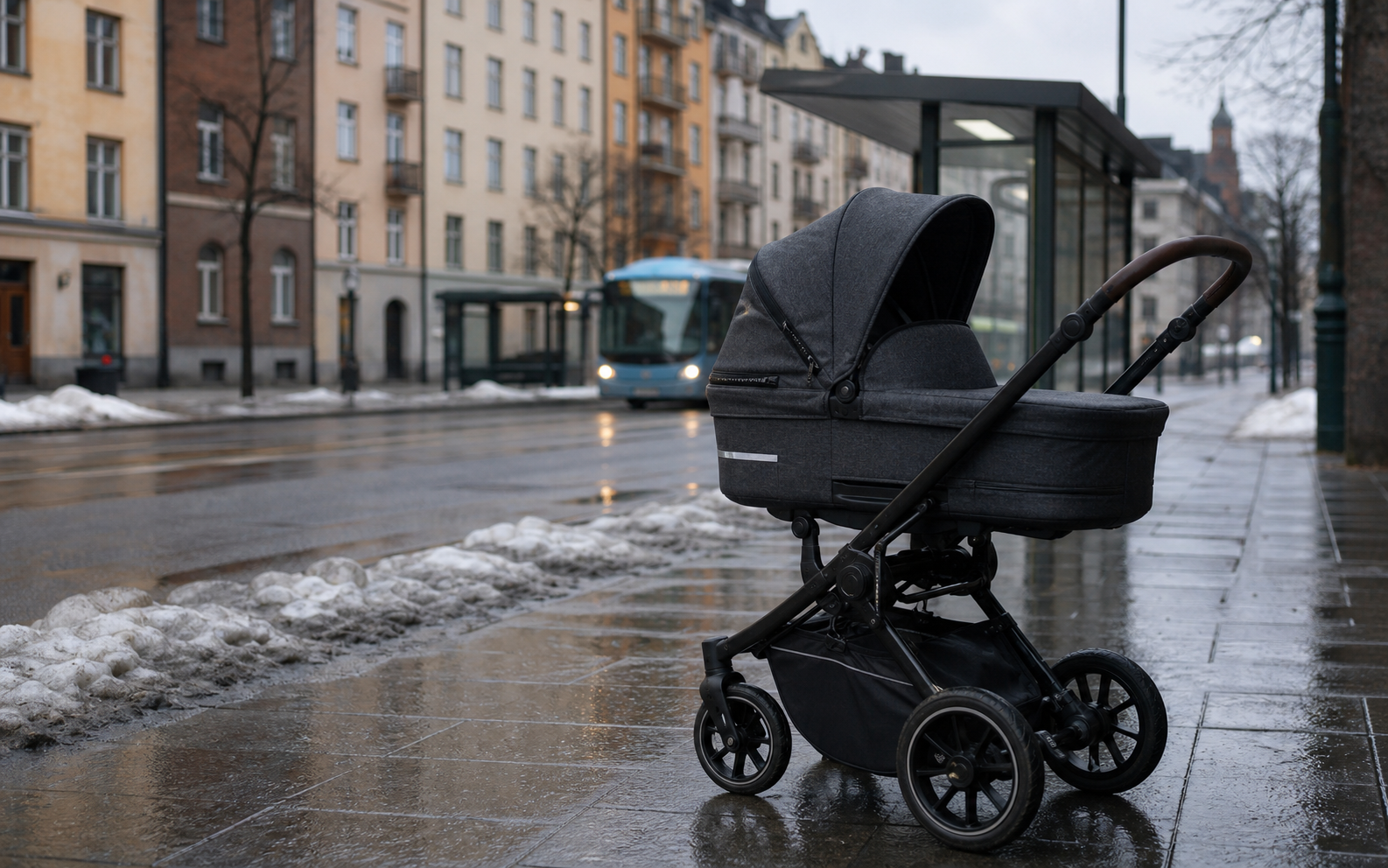
The best stroller for Sweden is not simply the biggest, most expensive, or most compact model you can find. It is the one that still works in February, fits your building, handles your real routes, and gives your child a safe, comfortable ride without turning every outing into a wrestling match.
Sweden is a stroller stress test: weather, surfaces, transit, storage, darkness, and newborn naps all matter. A stroller works well here when it can handle slush and uneven paths, fit your hallway or lift, board public transport without drama, and keep a baby comfortable without pretending that every bassinet is automatically safe for overnight sleep.
If you want products first, start with our best baby strollers in Sweden. Use this guide when you are still deciding what kind of stroller your Swedish daily life actually needs.
Start With Your Sweden, Not With the Stroller
Sweden is not one stroller environment. A family in a Stockholm apartment may care most about lift size, pram-room rules, and turning through tight entrances. A Gothenburg family may learn fast that rain covers, wipeable fabrics, and wet tram stops matter. In Malmö, short errands, buses, trains, and a small car boot can push you toward a more manageable fold. Farther north, winter walking can make bigger wheels and calmer suspension feel less like a luxury and more like the reason the stroller leaves home at all.
That means the first decision is not brand. It is use case:
- choose a comfort-first daily stroller if long walks, winter surfaces, newborn naps, and basket space matter most
- choose a compact city or travel stroller if storage, trains, car boot fit, and carrying weight dominate
- choose a premium all-rounder if you genuinely need comfort, durability, weather handling, and long-term use in one stroller
For a broad product shortlist, use the Sweden stroller shortlist after you know which of those paths sounds like your life.
The February Test
A stroller that works in May can still fail in February. Swedish winter is not just pretty snow. It can mean slush at crossings, packed snow on paths, gravel after ice treatment, wet leaves, curb edges hidden under snow, and park routes that change from smooth to stubborn in one week.
SMHI’s snow indicator is a useful reminder that Sweden is regionally uneven: snow cover varies over time and place, with southern Sweden seeing fewer snow-cover days while northern areas remain a very different winter environment. That matters for stroller buying because a compact city stroller that is fine for mostly cleared pavements in southern Sweden may be a poor main stroller for long winter walks farther north.
The practical rule is simple: if you expect long daily walks in winter, prioritize larger wheels, stable steering, suspension, and a chassis that does not shudder over rough ground. If your real life is storage-first and transit-first, accept that compactness has a cost. Small swivel wheels can be excellent in shops and stations, but they are rarely the easiest answer for slush, gravel, and uneven park paths.
Konsumentverket’s stroller guidance pushes the same kind of thinking: ask which surfaces you will use, test that the stroller feels stable on uneven ground and over small obstacles, and measure where it needs to pass. That is the February test in practice. Do not just ask whether a stroller folds nicely. Ask whether you would still choose to take it out after nursery pickup in wet snow.
The Hallway Test
The second Swedish test is less scenic: your hallway, lift, stairwell, pram room, and car boot.
A great stroller that is miserable to store is the wrong stroller. This is especially true in apartment life, where the daily friction may be a narrow lift, a shared pram room, a staircase you occasionally need to handle alone, or a hallway where wet wheels and grit quickly become part of the home.
Before buying, measure and rehearse:
- folded size, including whether it stands or has to lie flat
- weight you can actually lift with one adult
- width through building doors, lift doors, and storage doors
- whether wheels come off easily for the car boot or storage
- whether fabrics and wheels can be wiped after slush and gravel
- whether the basket is usable when the bassinet or seat is installed
Konsumentverket specifically tells buyers to consider lifts, stairs, door widths, buses, trains, cars, boot space, weight, folding, storage needs, and stability. Treat that as permission to be unromantic. If a stroller only works when two adults are calm and the weather is dry, it is not a good Swedish everyday stroller.
Public Transport Changes the Ideal Stroller
Public transport makes the ideal stroller narrower, calmer, and more predictable. The best stroller for a long park walk is not always the best stroller for a tram, bus, commuter train, or regional train when the stroller space is already half full.
Västtrafik’s stroller advice is concrete: place the stroller by the middle doors where there is space, brake it, fasten it with vehicle straps, and be ready to wait for the next departure if the stroller area is already full. UL similarly says strollers can travel without extra cost when space allows, that door widths vary, larger strollers such as twin models may not fit every bus, and the stroller should be placed in the intended area, strapped, and not block the aisle.
That changes what you should value. Frequent transit favors:
- manageable width
- predictable brakes
- easy turning in tight spaces
- a handle and frame you can control while boarding
- enough stability that the stroller does not feel nervous when parked
Luxury details matter less if the stroller is too wide, too awkward, or too heavy to position quickly. For city families who travel often by bus, tram, train, or metro, the best stroller may be the one that behaves well in crowded transitions, not the one that feels most plush on an empty pavement.
Newborns: Bassinet Comfort Is Not a Detail
For a newborn, the bassinet is not an accessory. It is the place where comfort, weather, ventilation, and safe positioning come together.
Konsumentverket says children under six months who cannot sit steadily should have a stroller with a flat lying position, and its bassinet guidance notes that a cold-season bassinet should be roomy enough for a warm footmuff without making the baby cramped. That is highly relevant in Sweden. A tiny bassinet can look neat in the shop and then feel wrong once the baby is in winter layers.
1177’s outdoor clothing advice also points toward layers and checking the child after a while. For babies lying still in a stroller, it mentions a footmuff, possibly a blanket, socks, thicker outer socks, mittens in very cold weather, and a hat, with airy layered dressing. The stroller has to leave room for that without blocking airflow or turning every check into a disturbance.
The safety boundary matters: 1177’s child-safety guidance includes advice on safe sleep surroundings, so daytime stroller naps during walks are not the same as unsupervised overnight sleep. Do not assume a stroller bassinet is automatically safe for overnight use just because it is flat, comfortable, or sold with a newborn setup. For that narrower decision, read Can my baby sleep overnight in the stroller? before treating any model as an overnight sleep option.
Dark Months Make Visibility a Feature
A stroller that works well in Sweden also works after dark, because winter darkness changes ordinary routines. Daycare pickup, the walk from the bus stop, a trip along a shared path, or a road crossing near home can all happen in low light.
Transportstyrelsen treats a person pushing a stroller as part of the pedestrian group and advises reflectors in darkness. Konsumentverket is even more direct about visibility products: reflectors make a major difference when it is dark, even in towns with street lighting, and children are best served by high-visibility options such as reflective vests when traffic visibility matters.
For stroller buying, that means visibility is not just an accessory thought. Check whether the stroller has useful reflective details, whether a rain cover hides them, and whether you can add reflectors or reflective accessories without creating loose cords or snag risks. A dark frame may look clean indoors, but winter use rewards being seen.
When Premium Is Actually Worth It
Premium is rational in Sweden when the extra money buys daily value you will truly use: smoother winter handling, better suspension, a stronger newborn setup, more durable fabrics and wheels, better basket access, easier repairability, and a frame that still feels composed after months of errands, gravel, and wet storage.
It is especially rational if you walk long distances, expect a second child, care about resale, or need one stroller to cover newborn use, winter walks, groceries, and daily transport. In that case, the more expensive stroller is not winning because it is nicer. It is winning because it lowers friction every day.
Premium is not rational if your lift is tiny, you carry the stroller often, you mostly use a car, or you need a lightweight second stroller more than a plush main stroller. A heavy high-end stroller that lives folded in a corridor because it is annoying to move is not premium in practice.
If this is your path, compare the best premium strollers in Sweden and read Is an expensive stroller worth it? before treating price as proof of fit.
When a Travel Stroller Is the Better Swedish Buy
A travel stroller can be the smarter Swedish purchase when your real constraints are a city apartment, trains, flights, a small car boot, daycare pickup, and toddler use rather than long newborn walks in winter. It can also be the better second stroller once your child is older and the main stroller feels too large for short trips.
The hard boundary is winter-heavy daily use. Many travel strollers are excellent second strollers but weak main strollers for Swedish February. Small wheels, limited suspension, lower baskets, shorter canopies, and less generous recline can all be acceptable compromises for travel and older babies, but frustrating compromises for daily winter walks with a young baby.
If compactness is the point, compare our best travel strollers in Sweden. Just be honest about whether you are buying your main stroller or your easiest stroller.
A Simple Sweden Filter
If you are stuck between stroller types, use the most annoying part of your week as the tie-breaker:
- February walks: choose the daily stroller with larger wheels and better suspension. Start with the Sweden stroller shortlist.
- Small lift or hallway: choose the stroller you can store and fold without resentment. Compare travel strollers if compactness is the real constraint.
- Newborn naps: choose the bassinet setup first, then check overnight sleep safety boundaries separately.
- Frequent transit: choose manageable width, reliable brakes, and easy turning over plush details.
- Second child planning: compare double strollers only after measuring storage, lift space, and your likely age gap.
Final Verdict
Choose for February, your hallway, and your real route. That is the shortest useful answer.
If your stroller can handle the worst month you realistically walk in, fit the building you live in, and behave well on the transport you actually use, it is far more likely to stay useful after the buying excitement fades.
For products, start with the broad Sweden stroller shortlist. If your priority is compactness, go to travel strollers. If your priority is comfort, winter handling, and long-term value, compare premium strollers.