
Radio Flyer EZ Fold 3956A
Pros / Cons
Pros
- The central pull strap folds the fabric body flat, while the handle stows against the wagon for storage.
- Two restrained child places can give way to cargo when the children are walking; the 68 kg allowance covers the whole load.
Cons
- This 3956A version has no canopy, so it does not provide the overhead shade of the separate 3957A model.
- It is a pull-only wagon from 18 months, not an infant stroller. The instructions rule out slopes and wet-weather use.
Product Facts
- From Age
- 18 months
- Max Load
- 68 kg
- Seat Capacity
- 2
- Modes
- Pull
- Product page
- Open product page
- Price/Buy
- Check price at Amazon
A folding wagon, not a daily stroller
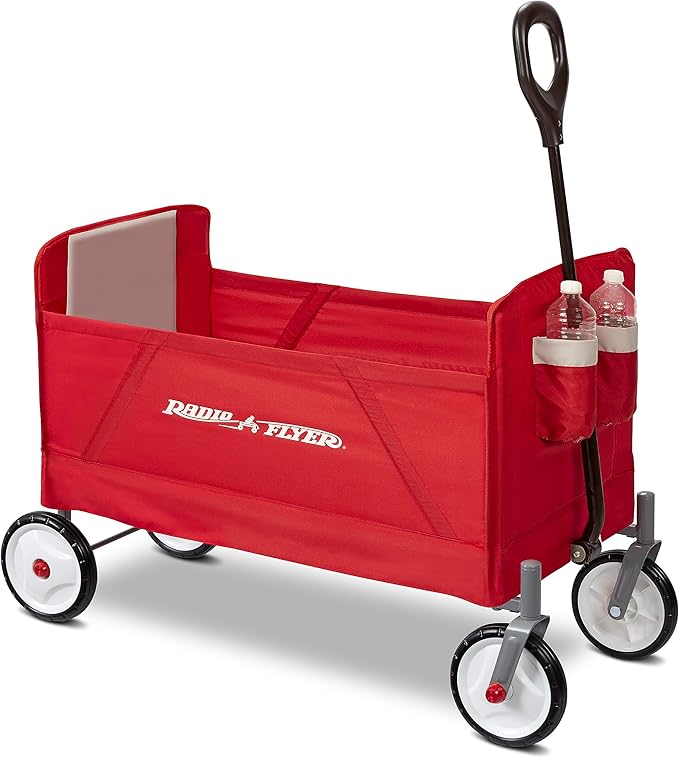
Radio Flyer EZ Fold 3956A is useful when two children sometimes need a seated ride and the family also carries picnic bags or other cargo. It starts at 18 months and allows at most two seated riders, with 68 kg for the entire load—not 68 kg per child. This version has no canopy; the canopy-equipped 3957A is a different model.
What makes storage easier
The centre strap pulls the fabric body into a narrow folded package, and the handle stows against the front. That is a practical advantage when an outing wagon would otherwise occupy too much storage space. The seats have restraints, and the two front cup holders keep drinks separate from the main compartment. It remains a wagon pulled by its front handle, not a pushchair with a rear push bar.
Keep the route within its limits
The 3956A instructions require the wagon to be fully unfolded and locked, with children seated, restrained and keeping their limbs inside. They rule out slopes, steps, traffic, pool areas, wet weather and outdoor use at night. A level, dry outing with adult supervision fits that brief; a hilly route or an infant’s everyday transport does not.